

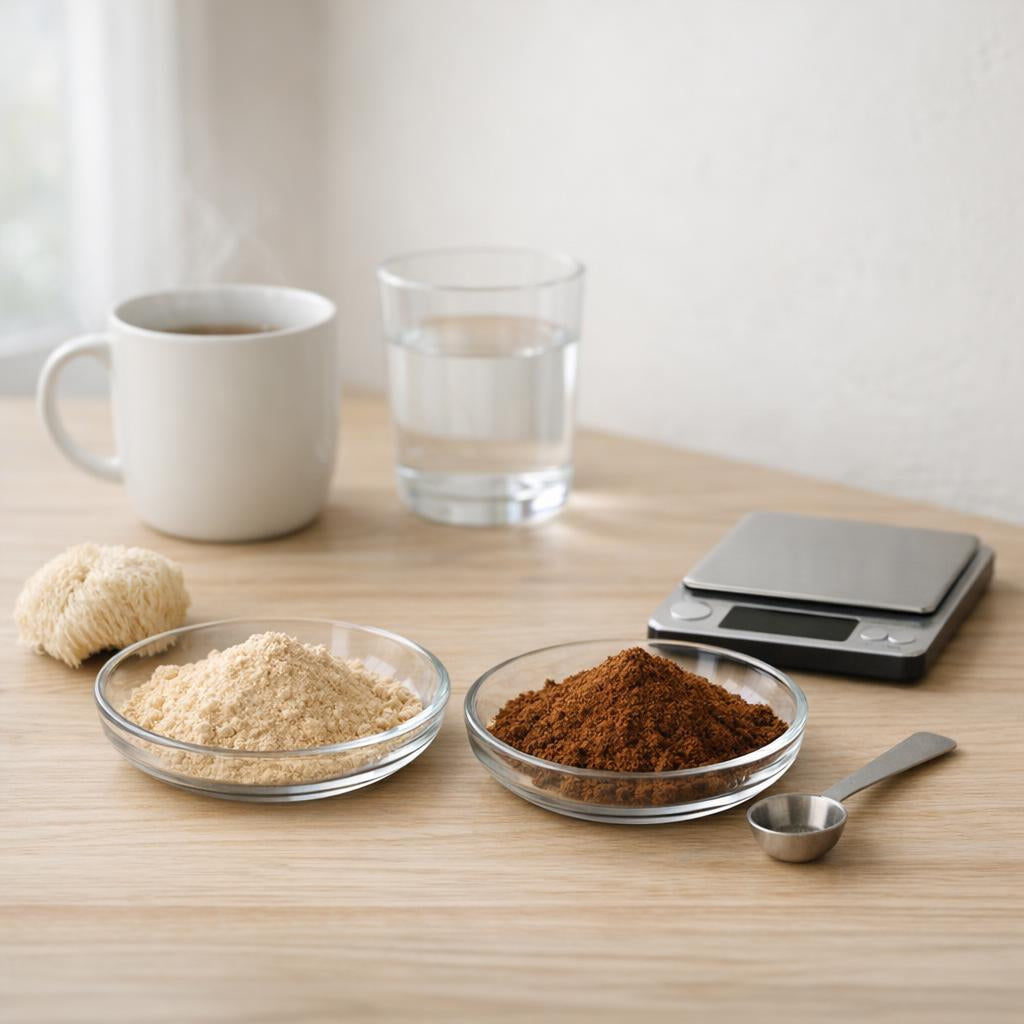
Not sure whether to choose Lion’s Mane powder or extract? Then it helps to first look at what you are actually comparing. Several product forms fall under the same name: non-extracted mushroom powder, extract powder, capsules with extract, and sometimes liquid tinctures. The main differences are in processing, concentration, ease of use, and what is stated on the label. In this article, you’ll read a clear and factual explanation of how Lion’s Mane powder and extract differ, what to look for when choosing, and how to read labels more effectively.
What is the difference between Lion’s Mane powder and extract?
The core idea is simple: Lion’s Mane powder is usually the dried and ground mushroom, while Lion’s Mane extract is a processed form in which compounds have been extracted from the raw material through an extraction process. That means powder and extract are not direct 1-to-1 alternatives.
With non-extracted powder, you generally get the full ground source material. With an extract, the material is first processed using, for example, water, alcohol, or a combination of both, resulting in a more concentrated end product. That is also why you more often see terms such as 10:1, 20:1, hot water extract, and dual extract on extract products.
In webshops and on labels, confusion often happens because the word “powder” is used for both forms. An extract powder is still a powder as a final form, but in substance it is different from raw or non-extracted Lion’s Mane powder.
What exactly is Lion’s Mane powder?
By Lion’s Mane powder, people usually mean dried Lion’s Mane mushroom that has been ground into a fine powder. It can be made from the fruiting bodies, from mycelium, or from a combination of both. That is exactly why the product name alone is often not enough to know what you are buying. If you want more background first, you can read What is Lion’s Mane mushroom?.
Non-extracted powder is often chosen by people looking for a minimally processed form or who want to use it in food and drinks. Think of adding it to smoothies, coffee, oatmeal, or recipes. Taste and texture often matter more here than they do with capsules.
The label does not always clearly state whether it is pure mushroom powder or an extract in powder form. So always look beyond the front of the package.
What is Lion’s Mane extract?
A Lion’s Mane extract is a processed form in which compounds are extracted from the source material. This can be done with hot water, alcohol, or both methods. If a brand refers to a dual extract, that usually means more than one extraction method has been used.
Extracts come in different final forms:
- as extract powder
- as capsules with extract
- as a liquid tincture
An extract is therefore not a separate product category in terms of form, but mainly a difference in processing. That makes it important not only to look at “powder or capsule,” but especially at “extracted or non-extracted.”
Why is extract often dosed differently from powder?
A common difference between Lion’s Mane powder vs extract is the amount per daily serving. In practice, non-extracted powder is often used in higher milligram or gram amounts than extract, because extract is a more concentrated form. As a result, you may see very different amounts on labels without the products being directly comparable.
When reading a label, the number of milligrams alone is therefore not enough. You also want to know:
- whether it is non-extracted powder or extract
- which extract ratio is used, such as 10:1 or 20:1
- which part of the mushroom has been processed
- whether the amount is listed per capsule, per serving, or per daily dose
So based on a higher milligram count alone, you cannot say which product is “stronger.” First, it has to be clear which form you are comparing. For practical label guidance, Lion’s Mane dosage: how much and how often is also relevant.
How does an extract ratio such as 10:1 or 20:1 work?
Extract ratios such as 10:1 and 20:1 basically indicate how much starting material was used to make one part extract. In theory, 10:1 means that ten parts of raw material were used for one part of final extract. That sounds simple, but in practice a ratio does not tell you everything about the final product composition.
An extract ratio is mainly useful as a starting point, not as the only proof of quality. A ratio does not automatically tell you:
- which part of the mushroom was used
- which extraction method was applied
- how the final product was standardized
- which batch analyses are available
So if you only see a large ratio on the packaging without further specification, you still have limited information. A complete label shows not just the ratio, but also the source, method, and analysis data.
Is a mushroom extract better than powder?
The question “are mushroom extracts better than powder?” has no universal answer. It depends on what matters most to you: minimal processing, convenience, concentration per serving, price per serving, or label transparency.
Extracts are often chosen by people specifically looking for a more concentrated form and clear product specifications such as extract ratio or certificates of analysis. Powder is more often chosen by people who want a simple, culinary, or less processed option.
For a fair comparison, do not only look at the product form, but at the full label picture. That prevents you from comparing a non-extracted powder with a highly concentrated extract as if they were the same type of product.
Fruiting body vs mycelium: why this difference matters
With Lion’s Mane products, you often see the terms fruiting body and mycelium. The fruiting body is the visible mushroom part. Mycelium is the root-like network through which the fungus grows. Both terms are used on supplement labels, but they do not refer to the same material.
Some products mention only Lion’s Mane without specifying which part was used. Other labels explicitly state 100% fruiting body or instead mycelium. There are also products where mycelium is grown on grain, which can make the composition harder to interpret if the label gives few details.
So when looking at Lion’s Mane powder or extract, always check:
- which part of the mushroom was used
- whether the label mentions fruiting body, mycelium, or both
- whether additional batch or analysis data are available
Which extraction methods do you come across?
Not every Lion’s Mane extract is made in the same way. On labels, you will mainly come across these terms:
- hot water extract
- alcohol extract
- dual extract
These terms describe how the extract was produced. A hot water extract uses water as the extraction medium, an alcohol extract uses alcohol, and a dual extract combines both approaches. Not every brand gives the same level of detail. Sometimes the label only says “extract,” without further explanation.
If you want to compare products, more transparency is usually more helpful than less. A specific label makes it easier to compare different Lion’s Mane extracts side by side.
Powder, capsules, or liquid form: which is more practical?
The People Also Ask question “Is Lion's Mane better in powder or liquid form?” is usually less about “better” and more about convenience. Each form has practical differences.
Powder
Powder is useful if you want to measure your own dosage or mix it into food and drinks. On the other hand, taste, solubility, and texture play a bigger role.
Capsules
Capsules are especially practical if convenience and a fixed daily dosage matter to you. You do not have to measure anything, and taste plays almost no role.
Liquid tincture
A tincture is compact and easy to use and is often chosen by people who prefer not to swallow capsules. However, concentration varies greatly by product, which makes label comparison even more important.
Lion’s Mane powder vs extract at a glance
| Category | Lion’s Mane powder | Lion’s Mane extract |
|---|---|---|
| Processing | Usually dried and ground | Extracted using water, alcohol, or both |
| Concentration | Often less concentrated | Often more concentrated per serving |
| Label terms | Powder, mushroom powder | Extract, 10:1, 20:1, dual extract |
| Use | Useful for recipes and drinks | Often chosen in capsules or as extract powder |
| Label dosage | Often higher in mg or grams | Often lower in mg due to concentration |
| Key check point | Fruiting body or mycelium? | Extract ratio, method, and analysis data |
What should you look for when choosing a Lion’s Mane product?
Whether you lean toward powder or extract, these checkpoints are the most useful when comparing products:
- Is the product non-extracted powder or an extract?
- Which part is used: fruiting body, mycelium, or a mix?
- Is the extraction method mentioned?
- Is there an extract ratio, such as 10:1 or 20:1?
- Is the dosage clearly listed per capsule, serving, or daily dose?
- Are certificates of analysis or batch details available?
- Is the label clear enough to truly compare products?
That transparency makes a big difference. A short label may look appealing, but sometimes it says too little to make a meaningful choice. You can also read What to know before you use Lion’s Mane.
What does Lion’s Mane powder taste like?
The taste of Lion’s Mane powder is usually described as mild, earthy, or slightly savory. How pronounced the taste is varies by product and application. In hot drinks, smoothies, or recipes, that taste may remain subtle, while when mixed plain with water it may be more noticeable. A common related question is: Lion’s Mane and coffee: preparation and taste tips.
With capsules, taste logically plays little to no role. That means taste mainly matters if you intentionally choose a loose powder or an extract powder that you mix yourself.
Are there also downsides or points of attention?
Besides form and label, there are also general points to keep in mind. One Lion’s Mane product is not automatically comparable to another product just because the same ingredient name appears on the front. Differences in source, processing method, and dosage can be substantial.
Also, always follow the label of the product you are using. If you have questions about use in your situation, for example in combination with other supplements or medication, it is wise to seek professional advice. For more context, you can read What to avoid when using Lion’s Mane. Also relevant: Side effects of Lion’s Mane.
When would you choose powder sooner, and when extract?
A practical rule of thumb:
- Choose powder sooner if you are looking for a less processed form and want to use it in food or drinks.
- Choose extract sooner if you are specifically looking for a more concentrated form and value clear product specifications.
- Choose capsules sooner if convenience and fixed dosing matter more to you than taste or culinary use.
So the best choice is not the same for everyone. It mainly depends on your preferred format, how you compare products, and how much information a brand provides on the label.
FAQ about Lion’s Mane powder vs extract
Is Lion’s Mane better in powder or liquid form?
Not necessarily. Powder and liquid tinctures mainly differ in convenience, taste, and concentration per product. Always look at the label, the dosage, and the product specifications.
Are mushroom extracts better than powder?
That depends on your goal when choosing a product. Extracts are often more concentrated, while powder is often less processed and easier to use in recipes.
Is extract powder the same as regular Lion’s Mane powder?
No. Extract powder is a powdered form of an extract. Regular Lion’s Mane powder usually refers to dried and ground source material without an extraction step.
What does 10:1 mean with Lion’s Mane extract?
That is an extract ratio. Basically, it means ten parts of raw material were used for one part extract. It is useful information, but not enough without extra details about source, method, and analysis.
How do I know whether a product contains fruiting body or mycelium?
That should be stated on the label or in the product specifications. If it is not clearly mentioned, it is difficult to compare the product properly in substance.
What does Lion’s Mane powder taste like?
Usually mild and earthy. The exact taste varies by product, preparation, and dosage.
What are the negative effects of Lion’s Mane?
Always consult the product label and the manufacturer’s information for directions and warnings. If you have questions about your personal situation, professional advice is the safest route.
Want to learn more about supplement labels and product forms?
Do you want to learn more about ingredients, dosages, and label information? Then explore the VIBEFUEL range or read more background in our knowledge base articles.
Share:
Magnesium for brain fog: facts, types and how to choose
What to drink in the morning for gut health?