

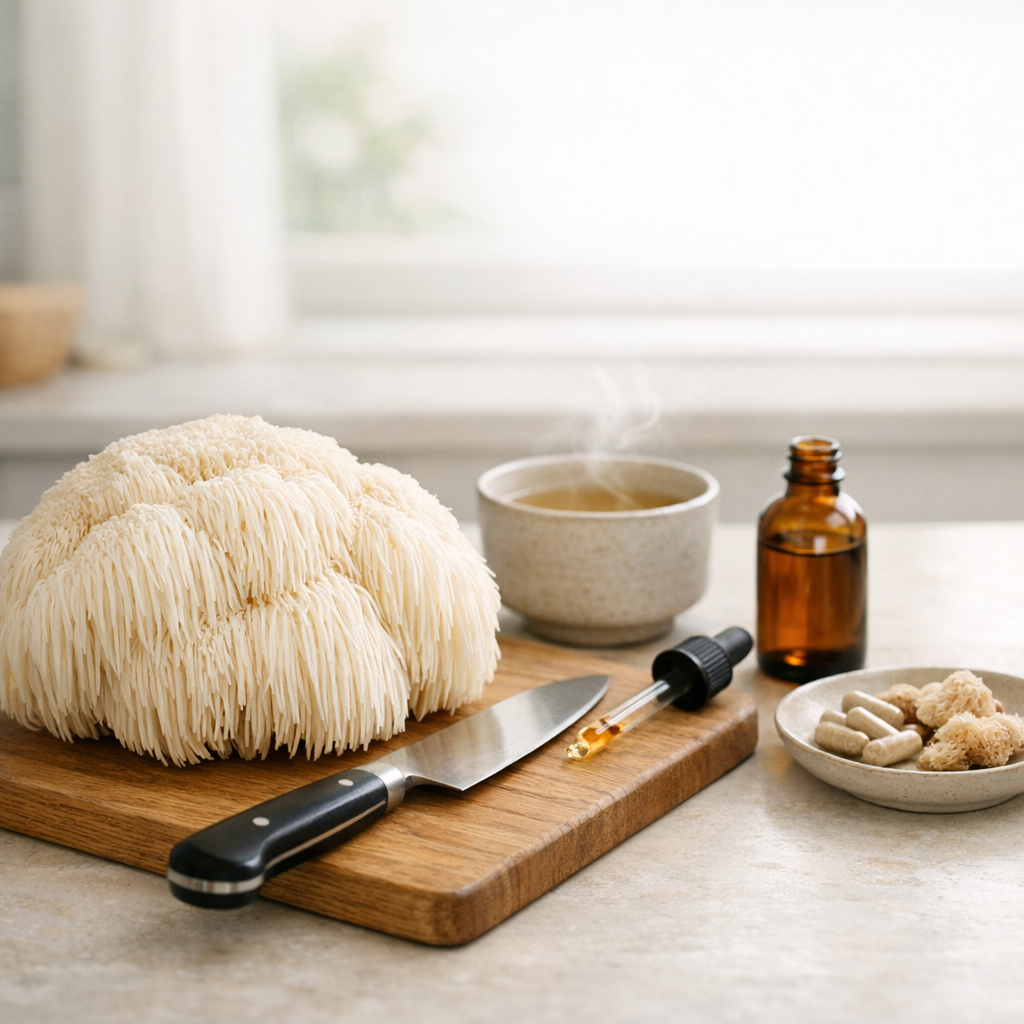
If you search for what is lion's mane, you’ll find a distinctive edible mushroom known by its Latin name Hericium erinaceus. In Dutch it’s also called “pruikzwam.” This mushroom grows in long, white spines and is known in the cuisines of Asia and Europe. In this guide you’ll read where Lion's Mane occurs, how to recognize it, how it tastes, the forms available for culinary use or as mushroom-based products, and what to consider if you’re thinking about a supplement. For broader context, first read: What are nootropics?
Origin, growth, and identification
Lion's Mane belongs to the toothed fungi and naturally grows on hardwoods such as beech and oak. You can recognize it by its striking white to cream clusters with soft spines that hang down like a waterfall. As the mushroom ages, the color can shift slightly toward yellowish. In Europe it’s fairly rare in the wild, while in parts of Asia it occurs more frequently. For that reason, Lion's Mane for culinary and product applications is usually cultivated on controlled substrate blocks, for example a mix of wood fibers.
The fruiting bodies appear in cooler seasons and give off a mild, fresh scent. For consumption, young, firm specimens are valued for their texture and subtle umami taste. In cultivation, growers precisely manage temperature, humidity, and oxygen to achieve consistent quality, which matters for flavor, structure, and color. Within the same category, Cordyceps is often discussed as well.
Culinary uses and flavor
Fresh Lion's Mane has a firm, fibrous structure that offers many options in the kitchen. Sliced or torn and sautéed in a little oil or butter, it develops a pronounced umami profile with a delicate, slightly seafood-like note. You can grill, roast, bread it, or use it as a component in ramen, risotto, and vegetable dishes.
Beyond the fresh mushroom, Lion's Mane also appears as dried pieces or as a fine powder. Dried can be soaked and then sautéed or simmered in broths. The powder can be used as a seasoning in soups or as a warm drink for a mushroom aroma without caffeine.
Composition and common forms of Lion's Mane
In the kitchen the focus is on flavor and texture. In mushroom-based products, a distinction is often made between the fruiting body and mycelium. You’ll also see terms like extract, extraction ratio, and information on polysaccharide or beta-glucan levels. Below is a brief overview of common forms and what to look for.
| Form | Core features | What to look for |
|---|---|---|
| Fresh | Firm, white fruiting body with long spines | Firm, not slimy, fresh smell |
| Dried | Long shelf life, soak before use | Clean origin, no foreign particles |
| Powder | Finely milled, neutral to earthy taste | Indication of mushroom part and purity |
| Extract | Concentrated, often with a ratio such as 10:1 or 20:1 | Clear extraction ratio, certificates of analysis if available |
Read more background on this ingredient and its composition in Lion’s Mane: background and composition.
What to look for in a Lion's Mane supplement
If you’re considering a supplement, a short checklist helps you read labels well and compare products.
- Mushroom part: whether it’s fruiting body, mycelium, or a combination.
- Extract or full spectrum: extracts should state an extraction ratio and sometimes the solvent method used.
- Analytical information: transparency on polysaccharide or beta-glucan levels and test reports if available.
- Origin and cultivation: country of origin and controlled growing conditions.
- Purity and safety: information on heavy metals, pesticides, and microbiology.
- Capsule or powder form: excipients, capsule material, and allergen listing.
- Label details: serving size, amount per serving, storage advice, and batch number.
Want practical context around forms and amounts? Read Lion’s Mane dosage: how much and how often?.
For a neutral explanation of use considerations, see Side effects of Lion’s Mane.
Frequently asked questions
What is Lion's Mane good for?
In the European Union there are no approved health claims for Lion's Mane. You can view it as an edible mushroom with characteristic flavor and texture used in cooking. The scientific literature studies this ingredient in various contexts, but this does not lead to permitted consumer claims. Base choices on label information, quality, and personal preference. For a claim-neutral overview of available studies, see Research on Lion’s Mane: what does the literature say?.
What are the characteristics of Lion's Mane tea?
Lion's Mane tea is typically a warm drink based on dried mushroom or powder, often caffeine-free. The flavor is mild and earthy. Prepare it by letting 1 teaspoon of powder or a few pieces of dried mushroom steep in hot water for 5 to 10 minutes and then straining. You can combine to taste with ginger, cinnamon, or plant-based milk.
Is Lion's Mane addictive?
Lion's Mane is an edible mushroom, and common professional literature does not indicate addictive potential. As with any food, individual sensitivity may vary. If you have a known mushroom allergy or are under medical supervision, discuss use with a healthcare professional.
Is Lion's Mane legal in the Netherlands?
As a food and as an ingredient in supplements, Lion's Mane is permitted within applicable regulations. In the wild the species is rare and protected in the Netherlands, meaning picking or disturbing it is not allowed. Cultivated variants are therefore used for consumption.
Share:
What is biohacking? Definition, measurement and methods
Best focus supplement - guide to choices and ingredients