

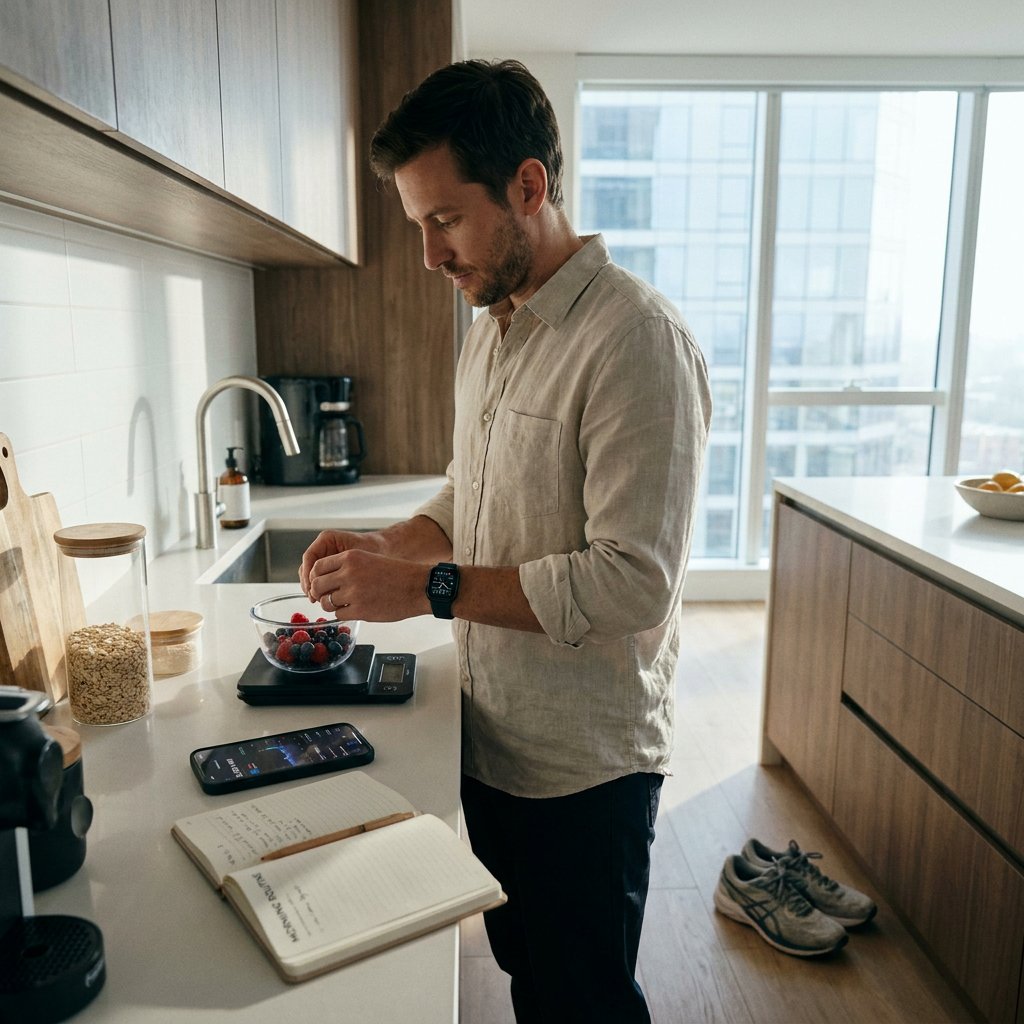
The five principles of biohacking give you a practical starting point for looking at your lifestyle more strategically. Instead of following random trends, you work from a clear foundation: measuring, nutrition, movement, sleep, and daily routines. That combination keeps coming back when people ask: what is biohacking, what is the foundation of biohacking, and what are the first steps in biohacking? In this article, you’ll read how these five principles are connected, why measuring matters so much, and how to start small and in a structured way.
What is the foundation of biohacking?
In practice, biohacking means becoming more aware of the factors that influence how you function every day. It is not just about gadgets, ice baths, or complicated protocols. The foundation of biohacking is much simpler: observe what you do, test changes, and then assess what those changes produce in your specific situation.
That makes biohacking above all a systematic way of looking at lifestyle. You do not change everything at once, but work step by step. You start with a baseline, make an adjustment, and then compare your experience or data afterward. That is what makes biohacking different from loose health tips that are supposed to work the same way for everyone.
When people ask what the main forms of biohacking are, they usually end up with lifestyle elements that return every day. Think of nutrition, movement, sleep, stress regulation, light, breathing, and the use of measurement data. For this article, we reduce that to five clear principles that are most relevant for most beginners.
The five principles of biohacking at a glance
The five principles of biohacking together form a practical foundation. They help you avoid getting lost in details and focus first on the elements that come back most often in successful biohacking routines.
- Measure before drawing conclusions
- Approach nutrition as a variable, not a fixed dogma
- Look at movement and recovery together
- Treat sleep as a fundamental pillar
- Keep daily routines small, repeatable, and personal
These five principles align well with what you see in search results: not one magical hack, but a method for experimenting with your own lifestyle more consciously.
1. Measuring is the first principle of biohacking
If you want to understand what biohacking is, you quickly end up with measurement. Without a baseline measurement, biohacking remains mostly a feeling. Measuring does not have to be technical or complicated. The goal is simple: you want to recognize patterns in what you do and how you respond to it.
For beginners, it is often enough to start with basic data such as sleep duration, bedtime, energy level, step count, training moments, and eating moments. You can track that in a notes app, spreadsheet, or wearable. More important than the tool is that you record consistently.
Measurement mainly helps prevent three mistakes. First, otherwise you change too much at once. Second, you may draw conclusions too quickly based on one good or bad day. Third, you start making assumptions about what works without seeing a real pattern.
A simple baseline measurement can look like this:
- track your bedtime and wake-up time for 7 days
- score your daily energy level from 1 to 10
- keep track of your eating moments
- record your movement, such as steps or training
- add notes about focus, cravings, or restlessness
Only then do you adjust one variable. For example, eating earlier in the evening, following a fixed sleep rhythm, or walking more during the day. That way, biohacking becomes not a collection of loose ideas but a controlled experiment.
What can you measure when you’re just getting started?
| Area | Simple measurement | Why this is useful |
|---|---|---|
| Sleep | Bedtime, wake-up time, perceived sleep quality | Gives insight into rhythm and recovery |
| Nutrition | Eating times, meals, craving moments | Makes patterns visible |
| Movement | Steps, training, sitting hours | Shows how much you really move |
| Energy | Daily score from 1 to 10 | Helps compare changes |
| Focus or productivity | Short daily note | Provides context alongside hard data |
2. Nutrition is a biohacking principle you test, not copy
One of the most important forms of biohacking is nutrition. Not because there is one perfect eating pattern, but because nutrition comes back every day and therefore produces a lot of data. Many people start biohacking through nutrition because you can relatively quickly see what fixed habits look like: when you eat, how often you snack, and at what times you feel hungry.
In biohacking, nutrition is less about blindly following a movement and more about observation. Some people experiment with less processed food, others with fixed eating windows, a different meal distribution, or a calmer breakfast structure (for example, the 30-30-30 breakfast rule). The point is not that one approach works for everyone. The point is that you compare in a structured way.
A practical starting point is to first bring more calm into your eating pattern. Eat at fairly fixed times, write down what you eat, and then change only one thing at a time. If you skip breakfast, change coffee, and adjust dinner all at once, you still will not know which factor made the difference.
Useful questions for this principle are:
- At what times of day do you eat most automatically?
- Are your eating moments predictable, or do they vary a lot?
- Do you notice a difference between workdays and days off?
- After certain meals, do you have more or less structure in your day?
Nutrition is therefore not a loose biohack trick, but a measurable lifestyle variable. That is exactly why it belongs in any explanation of the five principles of biohacking.
BEKIJK SUPPLEMENTEN MET DEZE INGREDIËNTEN
First steps to biohack your nutrition
- Keep a food log for 1 to 2 weeks
- Record not only what you eat, but also when
- Look at regularity first before testing complicated protocols
- Change only one nutrition variable per period
- Evaluate patterns, not one single day
3. Movement and recovery belong together
Anyone who links biohacking only to performance misses an important principle: movement only works well in the context of recovery. That is why this third principle is broader than just exercise. It is also about sitting, walking, training load, rest days, and the way your week is structured.
A common mistake is thinking that three workout sessions per week automatically means you move enough. In practice, long periods of sitting can simply exist alongside that. That is why many biohackers look not only at training, but also at daily movement. Steps, taking the stairs, walking moments, and short movement breaks often say more about your real rhythm than one intense session.
Recovery is the second half of this principle. If you want to understand your load, you also need to look at how your body responds to volume, intensity, and frequency. Some people use wearables for that, others a training diary or a simple score for muscle fatigue and energy. The core stays the same: movement without evaluation tells only half the story.
A practical start is to make both activity and recovery visible. Record not only when you train, but also how hard it felt, how much you slept, and how you felt the next day. That creates context. And context is exactly what makes biohacking useful.
Practical biohacks for movement
- Work with a daily minimum step goal
- Interrupt long sitting every hour with short movement
- Plan walking moments around fixed anchors in your day
- Track training and recovery in the same overview
- Increase load gradually instead of abruptly
4. Sleep is not an extra, but a foundation
In almost every serious explanation of biohacking, sleep returns as a foundation. That makes sense, because without sleep data and a sleep rhythm, it becomes difficult to properly assess other experiments. If you go to bed late, sleep irregularly, or keep shifting your rhythm, that also affects how you experience nutrition, movement, and routines.
Biohacking sleep usually does not start with expensive technology, but with consistent observation. What time do you go to bed, what time do you get up, how constant is that rhythm, and how do you rate your sleep when you wake up? Those are simple, useful data points. Only after that can you look further at evening light exposure, screen use, meal timing, and the difference between workdays and weekends. A practical framework for this is the 10-3-2-1-0 sleep hack.
What makes sleep a strong biohacking principle is that small adjustments are often easy to measure. A fixed bedtime, less variation in wake-up time, or a calmer evening routine provide clear comparison points. That is why sleep is for many beginners one of the first areas where you really learn how biohacking works: observe, adjust, compare.
If you are wondering what the first steps in biohacking are, sleep almost always belongs in your top three. Not as a separate topic, but as the base layer under everything else.
What can you adjust first around sleep?
- Choose a fixed wake-up time
- Record your bedtime for 7 days in a row
- Deliberately track evening screen time
- Include your last eating moment in your logbook
- Give your sleep quality a short score every morning
5. Daily routines make biohacking sustainable
The fifth principle of biohacking is often the difference between theory and practice: routines. Without routines, biohacks stay loose actions. With routines, they become repeatable. That does not mean you need a perfect morning routine or have to optimize every hour of the day. It mainly means creating fixed anchors within which behavior becomes automatic.
Good biohacking routines are small, clear, and measurable. Think of getting up at the same time every morning, taking a short walk after lunch, having a fixed moment to update your data, or doing a simple evening check of sleep and planning. Such routines are far more valuable than an extensive protocol you can only keep up for three days.
Routines also help make biohacking personal. What works for one person may not suit you. That is why this principle is not about copying the routine of an influencer or elite athlete, but about building a structure that fits your work, energy, and rhythm.
The strongest routines usually have three characteristics:
- they are linked to an existing moment in the day
- they involve little mental resistance
- they are easy to see in your tracking
People asking about the concept of biohacking often get technical answers. In practice, a lot comes down to this principle: make the desired behavior so simple that you can keep repeating it.
Want to translate this into a concrete daily structure? Check out the Biohack Protocol: practical guide & routine.
Why these five principles form the foundation
You could also divide biohacking into cold therapy, breathing, light, supplements, or wearables. Those are relevant topics, but they usually only work well once the foundation is already in place. That is why the five principles in this article were intentionally chosen as fundamental. They answer the question of what the foundation of biohacking is without immediately drifting into advanced methods.
Measuring creates objectivity. Nutrition shows daily patterns. Movement and recovery make load visible. Sleep gives context to almost everything. Routines ensure your approach remains doable. Together, they form a framework into which you can later place other forms of biohacking as well.
That is also why this approach is suitable for beginners. You do not need to buy a complete biohacker setup first. What you mainly need is a structure that teaches you how to look at your own behavior.
What are the first steps in biohacking?
If you want to start today, keep it small. The best first steps in biohacking are rarely spectacular, but they are consistent. Use the five principles as an order instead of trying to do everything at once.
- Do a 7-day baseline measurement
- Choose one focus area: sleep, nutrition, or movement
- Change only one variable per period
- Measure the same points before and after the change
- Only evaluate after enough days or weeks
For most people, this is a logical start:
- record your sleep rhythm
- track your eating moments
- measure your steps or movement moments
- give yourself a daily energy score
- briefly write down what stands out
That immediately lays the foundation for all future experiments. You learn not only what biohacking is, but above all how to apply it in practice.
Want a simple next step after that? Read more about The best biohack for beginners.
Common mistakes in biohacking
Many people start enthusiastically but make the same mistake: they change too much at once. Then the value of measuring disappears. You also often see people focus only on gadgets and less on behavior. Data without context has limited value.
Other common mistakes are:
- copying a protocol without checking whether it fits your daily schedule
- drawing a conclusion after only two days
- remembering only good days and forgetting bad days
- starting too complicated, which makes consistency difficult
- optimizing details while the foundation is still unstable
The five principles of biohacking help prevent exactly those pitfalls. They bring you back to a simple question: what exactly are you changing, how are you measuring it, and can you keep doing it?
When do supplements fit within biohacking?
Within biohacking, supplements are often mentioned as part of a broader approach. In practice, they usually do not come at the beginning, but later in the process. First you map your foundation through measuring, nutrition, movement, sleep, and routines. Only then can you determine where additional choices fit within your system.
For VIBEFUEL, biohacking is content-wise connected to a structured and practical approach. Anyone who wants to read more about this perspective can view the range or additional information on the site.
View the VIBEFUEL range
FAQ about the five principles of biohacking
What are the main forms of biohacking?
The main forms of biohacking usually revolve around lifestyle: measuring, nutrition, movement, sleep, routines, light, breathing, and sometimes cold exposure. For beginners, the five principles in this article are the most practical because they are directly applicable and easy to measure.
What is the concept of biohacking?
The concept of biohacking is that you test intentional changes within your lifestyle and then look at what that does in your situation. You use observation, structure, and sometimes technology to better understand patterns.
What is the foundation of biohacking?
The foundation of biohacking is not a gadget or trend, but a method. You start by measuring, choose one variable to adjust, and then compare the outcome. That is why measuring, nutrition, movement, sleep, and routines form a strong foundation.
What are the first steps in biohacking?
Start with a baseline measurement of about a week. Track sleep, eating moments, movement, and energy level. Then choose one area to improve, such as a more regular sleep rhythm or more daily movement. If you want an accessible next step after that, you can read more about the best biohack for beginners.
Do you need wearables to biohack?
No, wearables can be useful, but they are not required. A notes app, journal, or simple spreadsheet is often already enough to recognize patterns. Measuring consistently is more important than advanced equipment.
Are the five principles of biohacking only for serious athletes?
No, quite the opposite. The principles are broadly applicable because they are about daily habits. Anyone who wants to bring more structure to sleep, nutrition, movement, and routines can get started with them.
Why is measuring part of biohacking?
Measuring prevents you from making decisions based on feeling alone. It gives context to changes and helps you see patterns. That allows you to determine more deliberately what you want to keep, adjust, or stop.
Share:
Biohack protocol: practical guide for your routine
Main Areas of Biohacking Explained | VIBEFUEL