

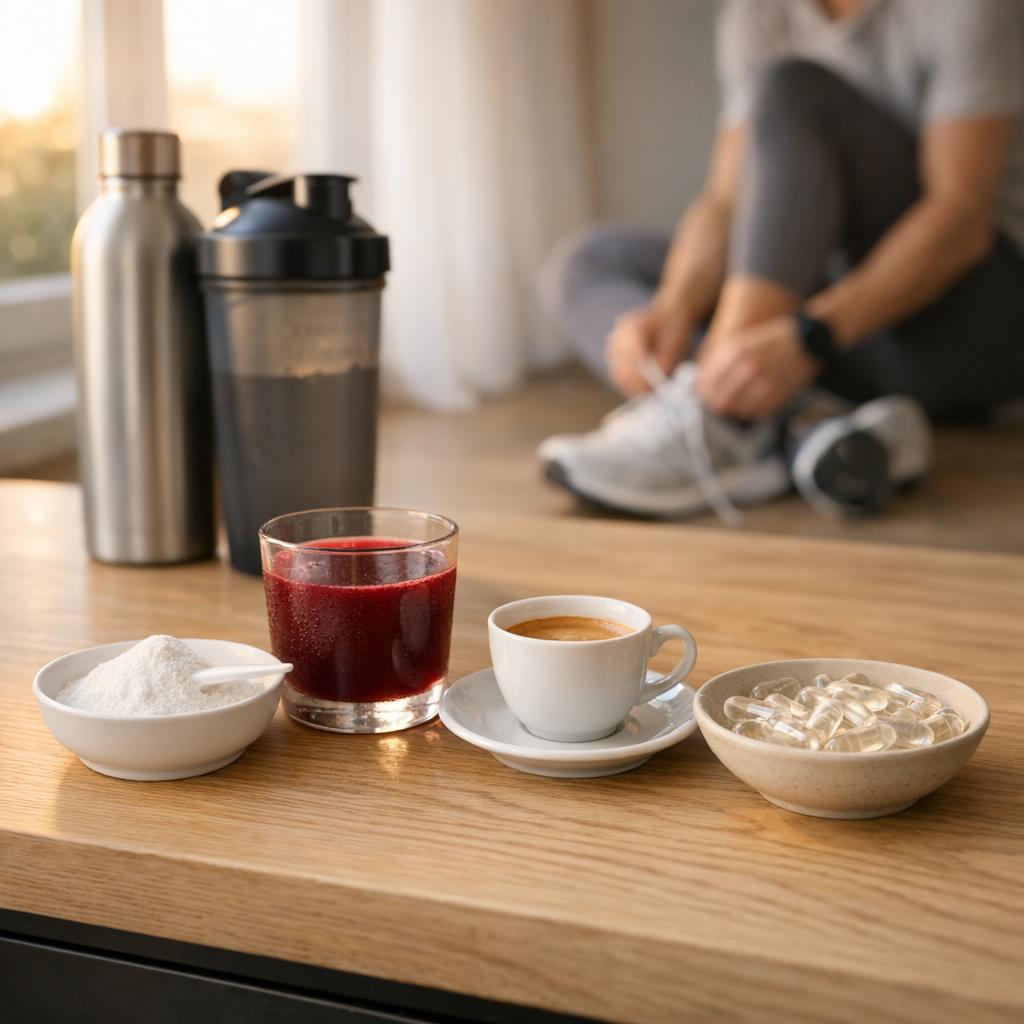
Anyone looking for proven supplements for sports performance usually does not want marketing talk, but clarity: which compounds have actually been studied, for what type of exercise are they relevant, and where are the biggest gaps between evidence and hype? That question makes sense, because many sports supplements become popular before their effects have been convincingly demonstrated.
The core is simple. For most athletes, nutrition, sleep, training structure, and recovery remain the foundation. Supplements come only after that. Within that group, there are only a limited number of supplements that consistently appear in the scientific literature on sports performance. Think mainly of creatine, caffeine, sodium bicarbonate, and nitrate from, for example, beetroot juice. Other well-known names, such as BCAA, magnesium, or general pre-workouts, have a very different level of evidence or are much more context-dependent.
In this article, you will read which supplements have been studied best, for which athletic goals they are mentioned, and where you should remain critical when using them and choosing products.
When are supplements for sports performance relevant at all?
Supplements are especially relevant when your training foundation is already in order. In practice, that means: adequate energy intake, enough protein and carbohydrates, good hydration, a logical training plan, and sufficient sleep. Without that foundation, the effect of a supplement is usually limited or hard to judge.
Relevance also differs greatly by sporting goal. A supplement that is mentioned in research for short, explosive efforts is not automatically interesting for endurance running. And something that may be useful for an experienced strength athlete does not necessarily add much for a recreational athlete who trains twice a week.
Supplements are therefore usually discussed within three situations:
- short and explosive efforts, such as sprinting, strength training, or team sports with repeated sprints
- endurance performance, such as running, cycling, or triathlon
- specific competition contexts, where timing, dosage, and tolerance become extra important
If you are wondering which supplements are proven effective, you will quickly end up with a small group of ingredients with relatively consistent research findings. The rest requires more nuance.
Which supplements are proven effective?
If you look at supplements most often described as proven or well-supported in relation to sports performance, these names come up the most:
- creatine
- caffeine
- nitrate, often from beetroot juice
- sodium bicarbonate
- in some contexts beta-alanine
That does not mean they are always suitable for everyone. It does mean that considerably more research is available for these compounds than for many other sports supplements. Protein shakes can also be practically useful, but they fall more under convenience and nutritional supplementation than under a classic performance-enhancing supplement with a directly measurable ergogenic effect.
Creatine for sports performance
Creatine is one of the most researched supplements in the sports world. In studies, it is mainly linked to short, intense, and explosive efforts. Think sprinting, strength training, weightlifting, and sports with repeated peak actions. The mechanism behind this revolves around the role of phosphocreatine in the rapid energy supply of muscles.
Creatine is therefore mainly mentioned for athletes training for strength, power, peak load, and training volume. For pure endurance performance, that is different. There, the context is less obvious and the performance effect is less direct.
In practice, creatine is usually used as creatine monohydrate, because that form has been studied best. If you want to read more about it, continue here: Creatine – what does the science say?. In a sports context, the focus is often on daily intake and consistent use, not just one isolated intake moment right before training.
Important points of attention:
- especially relevant for explosive and repeated high-intensity efforts
- not everyone notices the same degree of difference
- weight gain from water retention is common
- stomach or intestinal complaints can occur, especially with higher intakes at once
So if you are looking for an answer to the question which supplements can improve my sports performance, then creatine is one of the first compounds science often points to for strength- and sprint-oriented goals.
Caffeine as a proven supplement for sports performance
Caffeine is among the best-known and best-researched performance supplements. In studies, it is often discussed in relation to alertness, perceived exertion, and performance during endurance and interval exercise. It is exactly this broad application that makes caffeine so popular in sports nutrition and pre-workout products.
The response to caffeine does differ greatly from person to person. Factors such as body weight, habituation, timing of intake, and sensitivity all play a role. That is why the same product can work very differently for one athlete than for another.
In practice, athletes mainly look at timing and total daily intake. Because caffeine does not come only from supplements, but also from coffee, tea, energy drinks, and sometimes gels or bars, stacking can happen quickly. That makes careful use more important than many people think.
Well-known points of attention with caffeine are:
- restlessness or a jittery feeling
- sleep disruption, especially when used later in the day
- headaches
- stomach and intestinal complaints
- heart palpitations in sensitive users or at high doses
Precisely because caffeine appears so often in pre-workouts, fat burners, and energy drinks, label checking is important. More is not automatically better. With caffeine, performance is not only about dosage, but also about tolerance and timing.
Beetroot juice and nitrate for endurance efforts
Nitrate, often used through beetroot juice, is one of the better-known supplements in the endurance sports context. In research, it is mainly mentioned for efforts where oxygen efficiency and performance duration play a role. As a result, it appears more often in running, cycling, and other forms of endurance exercise than in pure strength training.
Interest in beetroot juice mainly comes from its nitrate content. Not every product is automatically comparable, because the amount of nitrate per shot, drink, or serving can differ. Timing of intake also matters in how athletes use it in practice around training sessions or competitions.
What makes beetroot juice difficult is that the outcome is not equally clear for every athlete or every situation. The evidence is more interesting than for many other popular supplements, but context remains important. You therefore mainly see this supplement among athletes who specifically focus on endurance performance and race preparation.
Practical points to watch:
- check the amount of nitrate per serving
- test its use in training first and not for the first time on race day
- pay attention to stomach and intestinal tolerance
- do not expect a universal effect in every type of sport
Sodium bicarbonate at high intensity
Sodium bicarbonate is usually mentioned for high-intensity efforts where acid buildup plays a role. Think shorter intense blocks, repeated sprints, or competition events involving several minutes of heavy work. That means it is not a typically broad daily supplement, but rather something discussed in a specific performance context.
Scientific interest has existed for a long time, but in practice the biggest challenge is often tolerance. Many athletes experience stomach or intestinal complaints. That makes it a supplement you can only seriously assess if you test dosage, timing, and individual response well outside competition moments.
For recreational athletes, this is usually not a first choice. For dedicated athletes in specific disciplines, it can be more interesting, but even then only if the practical implementation is right.
Beta-alanine: sometimes relevant, but context-dependent
Beta-alanine is regularly mentioned in lists of the best supplements for sports performance, but the evidence is less broadly applicable than for creatine or caffeine. In research, it is mainly linked to efforts where duration and intensity fall within a specific range. That means it is not a universal supplement for every athlete or every training goal.
A well-known practical point is the tingling of the skin that some users experience. That by itself says little about performance, but it is a frequently mentioned side effect with use. Here too, a popular name does not mean it is automatically relevant for your sport.
Supplements that are often popular, but less convincingly proven
A large part of the market consists of supplements that are well known through social media, fitness content, or broad sports marketing, but for which the evidence for direct sports performance is more limited. This is often true, for example, for:
- BCAA
- general pre-workout blends with many separate ingredients
- magnesium as a performance product without a confirmed deficiency
- multivitamins as a direct performance booster
- post-workout formulas with long ingredient lists
So the fact that a product is popular does not automatically mean it belongs to the proven supplements for sports performance. With blends, it is extra difficult to judge the effect, because dosages are sometimes unclear and several ingredients are combined at the same time. Then you not only know less well what you are taking, but also less well which part is relevant.
Are protein shakes proven for sports performance?
Protein shakes are often put in the same category as performance-focused sports supplements, but functionally they are something else. A protein shake is first and foremost a practical way to supplement protein intake. That can make it useful within a dietary pattern, especially for athletes who struggle to get enough protein through regular food.
For direct acute performance improvement during a training session or competition, protein shakes are usually not discussed in the same way as creatine or caffeine. Their role lies more in total daily intake, recovery planning, and convenience. That is why it is more accurate to see protein powder as nutritional supplementation rather than as a classic performance-enhancing supplement.
Pre-workout: category or proven supplement?
Pre-workout is not a single ingredient, but a product category. That means the name by itself says little. One pre-workout contains mainly caffeine, while another combines it with citrulline, beta-alanine, creatine, vitamins, sweeteners, and flavorings. Sometimes the exact dosages are clearly stated on the label, and sometimes they are not.
If you want to know whether a pre-workout is proven, you should therefore not look at the product name, but at the individual ingredients and their dosage. A pre-workout can contain a proven ingredient, such as caffeine or creatine, but that does not automatically make the whole formula proven effective.
So always check:
- which ingredients it contains
- how much of each ingredient is present
- whether total caffeine intake remains reasonable
- whether it contains many unclear proprietary blends
Nutrition remains more important than supplements
The top results in Google rightly emphasize this: supplements never work independently from the rest. Anyone who structurally eats too little, sleeps too little, uses too few carbohydrates around hard training sessions, or has an illogical recovery rhythm will rarely make a fundamental difference with supplements.
For sports performance, the foundation usually remains:
- sufficient total energy intake
- an appropriate amount of protein
- sufficient carbohydrates for intense or longer efforts
- good fluid intake
- sleep and recovery
- a training schedule that fits your goal
Only when this foundation is solid does it make sense to critically look at supplements for sports performance.
How do you choose a supplement safely?
Choosing safely is at least as important as choosing based on evidence. Analyses and studies have shown for years that some products can contain compounds not listed on the label, have a much higher dose than expected, or use problematic combinations. Products with many ingredients especially require extra attention.
So pay attention to these points:
- buy from a reliable provider with clear labeling
- check the ingredient list and dosage per serving
- be critical of products with extremely many active compounds at once
- do not thoughtlessly combine with coffee, energy drinks, or other stimulating products
- try new supplements first outside important competitions
- pay attention to possible risks for doping controls if you are active in a tested sport
For competitive athletes, that last point is especially important. Contamination or undeclared substances are not a theoretical problem. That is exactly why transparency of composition is essential.
Overview: proven supplements by sporting goal
| Sporting goal | Supplement often mentioned | Note |
|---|---|---|
| Strength and explosiveness | Creatine | Especially relevant for short, intense efforts |
| Endurance performance | Caffeine, nitrate from beetroot juice | Timing and individual response are important |
| Repeated high intensity | Creatine, caffeine, sodium bicarbonate | Not every supplement is equally well tolerated |
| General nutritional supplementation | Protein powder | Practical as an addition, but not a classic ergogenic supplement |
Which supplements are best for sports performance?
There is not one best choice for everyone. The best supplement depends on your sport, intensity, training frequency, and goal. Still, based on the current state of research, you can roughly say:
- for strength and explosiveness, creatine usually ranks highest
- for endurance and competition alertness, caffeine is often mentioned first
- for some endurance sport scenarios, nitrate from beetroot juice is relevant
- for specific high-intensity efforts, sodium bicarbonate can be interesting
The best supplements for sports performance are therefore not necessarily the most popular products, but the ingredients with the clearest match between evidence and application.
FAQ
Which supplements can improve my sports performance?
The supplements that appear most often in research are creatine, caffeine, nitrate from beetroot juice, and sodium bicarbonate. Which of these is relevant depends on your sporting goal and type of effort.
Which supplements are proven effective?
Within a sports context, creatine and caffeine are especially widely recognized as well-researched ingredients. Nitrate and sodium bicarbonate are also regularly mentioned, but mainly in more specific situations.
Are all pre-workouts proven?
No. Pre-workout is a collective term. Only individual ingredients within a formula may be well researched. That is why you should always look at composition and dosage.
Are BCAA and magnesium proven for better sports performance?
They are much less convincingly supported as direct performance products than creatine or caffeine. Magnesium can be relevant in the case of a deficiency, but that is different from demonstrable performance improvement in every athlete.
Are protein shakes the same as performance-focused supplements?
No, usually not. Protein shakes are mainly a practical addition to your diet. They are less often seen as supplements with a direct acute performance outcome such as caffeine or creatine.
Can you still get lean after 40?
Age in itself does not rule out athletic progress. Results mainly depend on training, nutrition, recovery, consistency, and lifestyle. Supplements are always secondary to the foundation.
How do you know whether a sports supplement is reliable?
Look for clear labels, transparent dosages, a reliable provider, and be extra cautious with products that contain many ingredients or vague blends. For competitive athletes, extra control is important because of possible contamination.
Read more about ingredients and supplements
If you want to dive deeper into individual ingredients and formulations, also see:
Share:
Using Lion's Mane every day? Here's what to know
5R gut repair model: explanation of the 5 steps