

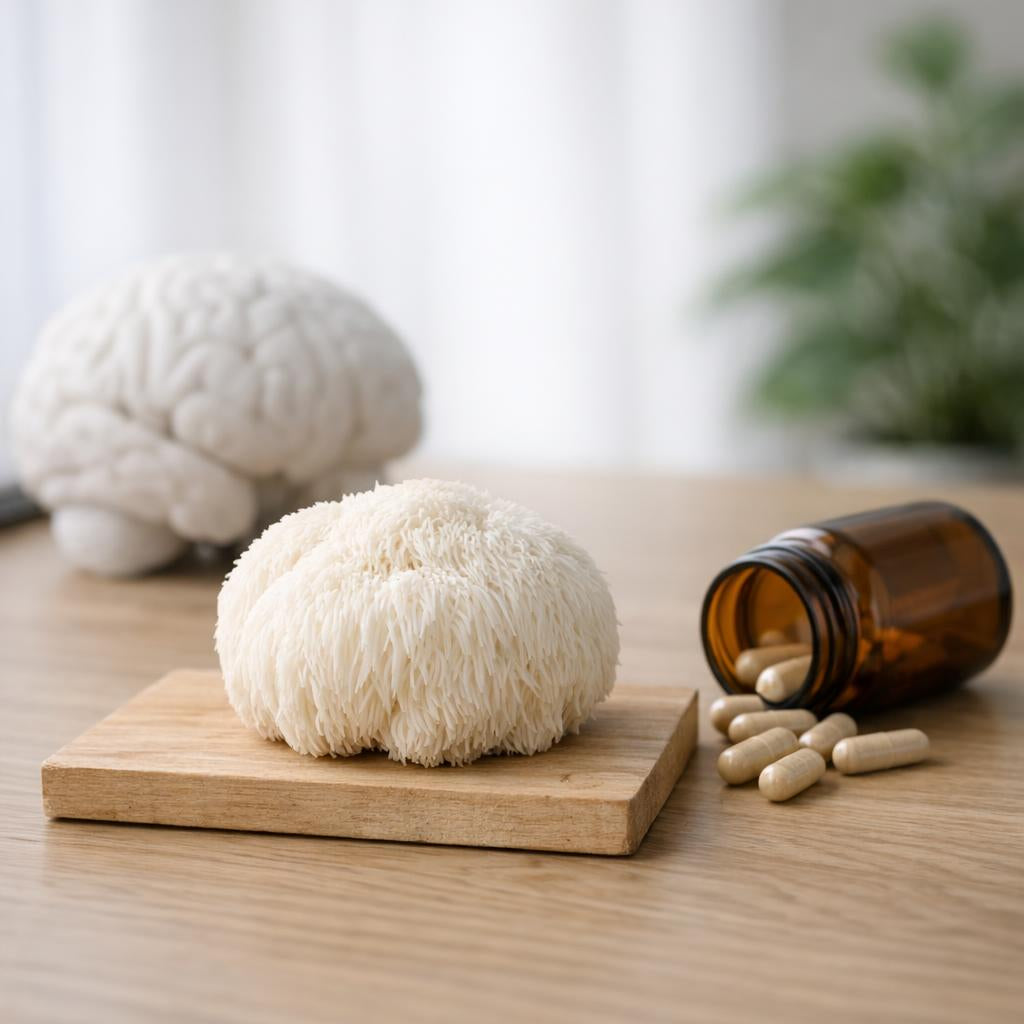
Are you looking for factual information about Lion's Mane and the brain? In this guide, you will find a neutral explanation of Hericium erinaceus (Lion's Mane), how it is used in foods and supplements, which research themes are discussed in the scientific literature around the brain, and what to look for in terms of quality and safety. This article is informational, free of claims, and aligned with EU regulations.
What is Lion's Mane (Hericium erinaceus)?
Lion's Mane, also known in Dutch as pruikzwam, is an edible mushroom with white cascading spines that resemble a lion's mane. The species occurs naturally in parts of Asia, Europe, and North America and is valued in culinary use for its firm texture. In various cultures, the mushroom has been described for centuries in cookbooks and herbal texts. Today, Lion's Mane is eaten fresh as well as processed into dried powder or extract, and it can be found as a standalone ingredient or as part of blended formulas. Its Latin name is Hericium erinaceus. In a supplement context, it is important to know which part is used: the fruiting body, the mycelium, or a combination of both, because this partly determines the composition shown on the label.
Lion's Mane and the brain: what you can factually say in the EU
In the European Union, EFSA evaluates health claims for foods and ingredients. There are currently no approved health claims for Lion's Mane. This means consumer communication may not suggest effects or results for the brain, memory, concentration, or similar topics. It is, however, allowed to factually describe what the ingredient is, how it is traditionally or culinarily used, and that there is international scientific literature in which a range of research questions about Lion's Mane and brain-related topics are being studied.
When searching for or comparing information, pay attention to whether sources use neutral wording, avoid drawing conclusions beyond what scientific publications actually report, and are clear about methods and context. Below, you will find an overview of research themes that appear in the literature, without making statements about outcomes or effectiveness. See also: Is there evidence that Lion’s Mane works?.
Research themes in the literature around the brain
Preclinical models and biomarkers
Some publications concern laboratory and animal research. In this type of study, standardized models and biomarkers are often used to map biological processes. Examples of terms you may encounter in methods sections include nerve growth factors and neurobiological markers, oxidation and inflammation parameters, and cell viability tests in cultured cells. These reports mainly focus on measurement methods, dosage levels within the model, and duration of exposure. The results and interpretation of such models are specific to the design studied and cannot simply be translated one-to-one to humans.
Clinical study designs and test methods
In addition to preclinical work, there are also publications involving human participants. These may include standardized questionnaires, computer tasks, and scoring instruments used in research settings to map mental functions. Think of general cognitive screenings, reaction-time tasks, learning and memory tests, or questionnaires about daily functioning. Methodologically, aspects such as study duration, composition of the product used, intake protocol, and compliance are described. Interpretations in the discussion section of articles are linked to the specific population, measurement tools, and statistical approach of the study in question.
Research lines you often see recurring
- Studies with healthy adults in which performance on standardized tasks is measured within a predefined period.
- Exploratory literature on ageing and brain-related themes within clinical and preclinical frameworks.
- Publications in which sleep and mood questionnaires appear in relation to dietary patterns or specific ingredients.
- Research into the gut-brain axis, in which microbiome composition and food components are described in parallel.
The choice of measurement methods, population, and duration differs greatly per study. It is advisable to consult full articles for context, limitations, and definitions used. For related educational context around the brain, you can also consult our other knowledge base articles.
Composition and nutritional value of Lion's Mane
As an edible mushroom, Lion's Mane consists of water, dietary fiber, carbohydrates, and protein, with a low fat content. As with many mushrooms, it contains various minerals and trace elements, including potassium and phosphorus, and modest amounts of zinc and copper. B vitamins also occur naturally, such as niacin and riboflavin. In addition to macro- and micronutrients, the literature describes various classes of compounds characteristic of mushrooms, such as polysaccharides and specific aromatic or terpene-like compounds that may vary by species and growing conditions.
The exact composition depends on factors such as substrate, cultivation method, part of the mushroom used (fruiting body or mycelium), harvest timing, and any post-processing such as drying or extraction. As a result, products can differ in their content of dietary fiber, protein, and other compound classes. When comparing labels, pay attention to specifications such as the part used, extract ratios, and standardizations.
Forms, quality and labeling
On the market, you will find Lion's Mane as a culinary ingredient and as a supplement. The form used partly determines the characteristics of the final product. The table below provides a factual overview to help you read labels and compare products.
| Form | Component | Characteristic | What to check on the label |
|---|---|---|---|
| Fresh or dried for food use | Fruiting body | Culinary use in dishes | Origin, cultivation method, and storage instructions |
| Dried powder | Fruiting body | Finely milled, 100% powder | Part used and origin listed, no fillers |
| Extract 1:1 to 10:1 | Fruiting body | Extraction ratio indicates concentration step | Extraction method and ratio clearly stated |
| Mycelium on grain | Mycelium | Contains mycelium and carrier | Specific statement of mycelium and carrier fraction |
| Blended formula | Combination | Multiple ingredients per capsule | Full ingredient list and per-serving amounts |
Quality information that is stated transparently - such as the part used, extraction method, and batch control - helps you compare products objectively. If in doubt, ask for product specifications or certificates of analysis.
Dosage in studies and use in food
Scientific literature describes a wide range of intakes and study durations. Publications using fruiting body powder often report daily intakes in gram amounts, while studies using concentrated extracts describe lower milligram amounts per day. Duration also varies, from several weeks to several months, depending on the research question and study design. Because designs and products used differ greatly, results and figures are not directly comparable. This overview is for informational purposes only and is not intake advice. For practical, claim-free information, you can read our explanation on dosage: how much and how often.
As a culinary ingredient, Lion's Mane is prepared like other edible mushrooms: pan-fried, stir-fried, or stewed. The preparation method determines texture and flavor and affects moisture content and portion size. A frequently asked question is drinking coffee after Lion's Mane; this is discussed in our explanation.
Questions about timing? Does Lion’s Mane work better in the morning or evening?
Safety, side effects and interactions
Publications and product labels generally describe Lion's Mane as suitable for use within normal food or supplement dosages. Individual sensitivity can, however, differ. In consumer settings, mild digestive complaints or skin reactions are occasionally mentioned. People with a known mushroom allergy should avoid the ingredient. During pregnancy, breastfeeding, autoimmune conditions, or before planned surgery, it is sensible to consult a doctor in advance. Read more about side effects of Lion's Mane.
Take extra care with possible interactions if you use medication. Informational sources mention the following points for attention, among others:
- Anticoagulants - consult a doctor or pharmacist about concurrent use.
- Blood sugar-lowering medication - monitoring and professional advice are recommended.
- Immune-related medication - discuss additional use with the treating professional.
Stop use if unwanted reactions occur and contact a professional. This section is informational and does not replace medical advice.
Other mushrooms and the brain - overview of research lines
There is broad interest in mushrooms as a food group. In the literature, species besides Hericium erinaceus are also discussed, such as Ganoderma lucidum (reishi), Cordyceps, and Inonotus obliquus (chaga), in relation to a range of research questions, including subjects connected to the brain. As with Lion's Mane, publications vary in design and population, and there are no approved EU health claims for brain-related themes for these species. Anyone exploring this topic should read primary sources and distinguish between traditional use, nutrition science, and modern research reporting.
Frequently asked questions
Is Lion's Mane good for your brain?
In the EU, there are no EFSA-approved health claims for Lion's Mane in relation to the brain, memory, or concentration. There is international scientific literature exploring brain-related research questions. This guide remains neutral and does not draw conclusions about effects. Always discuss personal choices with a professional.
What are the negative effects of Lion's Mane?
No generally established negative effects are known for normal culinary use. Individually, mild digestive complaints or skin reactions may occur. Avoid use if you have a known mushroom allergy. Consult your doctor if you are pregnant, breastfeeding, have autoimmune conditions, planned surgery, or use medication, especially anticoagulants or blood sugar-lowering drugs.
Which mushrooms are often the subject of brain-related research?
Publications mention Hericium erinaceus (Lion's Mane), Ganoderma lucidum (reishi), Cordyceps, and Inonotus obliquus (chaga), among others. The EU has no approved health claims for these species in relation to brain-related themes. Consult primary literature for context and methods.
What does Lion's Mane do to your body?
As an edible mushroom, Lion's Mane provides nutrients such as fiber, protein, and minerals, comparable to other culinary mushrooms. Outside that general nutritional context, there are no EU-approved health claims. How someone chooses to include it in their diet is a personal decision.
How do you choose a Lion's Mane product?
Check the part used (fruiting body or mycelium), the form (powder or extract), any extract ratios, the full ingredient list, origin, and batch information. Transparent labeling helps with objective comparison. Ask for product specifications if needed.
Would you like to view product information without health claims? View our product with Lion's Mane: Daily Focus Formula. Prefer to read more about the ingredient itself first? Go to: Read more about this ingredient.
Share:
Nutrition for brain fog: a neutral, practical guide
Using Lion's Mane every day? Here's what to know