

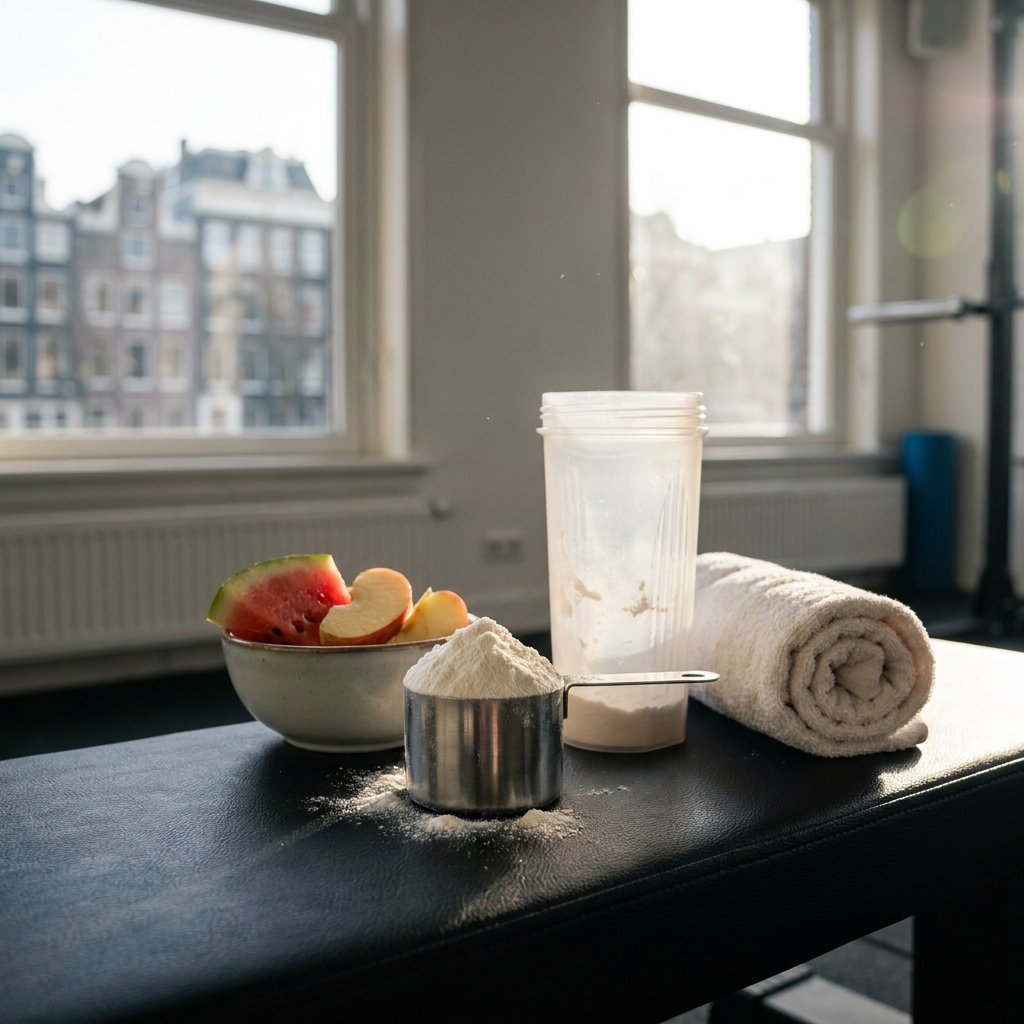
Citrulline malate is a combination of the amino acid L-citrulline and malate, also known as malic acid. You mainly come across it as a powder or as an ingredient in sports supplements and pre-workouts. The best-known variant is citrulline malate in a 2:1 ratio, in which two parts L-citrulline are bound to one part malate. Below you can read what citrulline malate is exactly, how it differs from pure L-citrulline and which product information matters when you compare supplement labels.
The composition of citrulline malate
L-citrulline is a non-essential amino acid. That means your body can make it itself. Citrulline also occurs naturally in food, with watermelon as the best-known example. The name citrulline is in fact derived from the Latin word for watermelon: Citrullus.
Malate is the salt form of malic acid. Malic acid occurs naturally in various kinds of fruit, including apples. In supplements, malate is combined with L-citrulline to form citrulline malate. On a label it may also appear as L-citrulline malate, citrulline malate or citrulline malate powder.
What does the 2:1 ratio mean?
Many products contain citrulline malate in a 2:1 ratio. This means the raw material consists of two parts L-citrulline and one part malate. A 6-gram serving of citrulline malate 2:1 therefore does not contain 6 grams of pure L-citrulline. The exact amount of L-citrulline depends on the raw material used and the stated ratio.
There are also products with a 1:1 ratio. That is why it is wise to look not only at the front of the pack, but also at the ingredient list and the nutrition table. That is usually where it says how many grams of citrulline malate a daily serving contains.
The difference between L-citrulline and citrulline malate
L-citrulline and citrulline malate are often mentioned in the same context, but they are not identical. Pure L-citrulline contains only the amino acid. Citrulline malate contains L-citrulline combined with malate. So the form you see on a label determines how much of the total amount is L-citrulline.
| Form | Composition | What is often on the label? |
|---|---|---|
| L-citrulline | L-citrulline only | For example 3,000 mg L-citrulline per serving |
| Citrulline malate 2:1 | Two parts L-citrulline and one part malate | For example 6,000 mg citrulline malate 2:1 per serving |
| Citrulline malate 1:1 | Equal parts L-citrulline and malate | For example 6,000 mg citrulline malate 1:1 per serving |
The terms are sometimes used interchangeably online. So always compare the full product specification. Especially with flavoured powders, capsules and complete pre-workouts, the amount of citrulline malate per recommended daily dose can vary widely.
Why citrulline malate often appears in sports supplements
Citrulline malate is a much-discussed ingredient in the sports nutrition category. In scientific literature it is studied in relation to, among other things, physical exertion, metabolic processes and the conversion of citrulline into arginine. Arginine in turn is involved in processes in which nitric oxide plays a role. See also Proven supplements for sports performance.
Researchers study citrulline malate in a range of study designs, for example around strength training, repeated exertion and endurance protocols. Results between studies are not always directly comparable. This is partly due to differences in amounts used, the ratio of the raw material, the duration of the study, the type of exercise and the participant group. For background on oxygen uptake and training foundations, see VO2 max.
No authorised health claims have been established for citrulline malate in the European Union. Supplement providers are therefore not allowed to attach health or performance claims to citrulline malate. Information about this ingredient should remain factual and neutral.
Citrulline malate powder, capsules or pre-workout
Citrulline malate powder is a common form. An advantage of a loose powder is that you can weigh the amount and easily check the ingredient list. Pure variants usually contain only citrulline malate, without flavourings, sweeteners or other substances.
Capsules and tablets are an alternative for anyone who doesn't want to mix powder. Because the content per capsule is usually limited, the number of capsules per serving can add up. So always check how many milligrams of citrulline malate one capsule contains and how many capsules together make up one serving according to the label.
Citrulline malate also regularly appears in pre-workouts. There it is combined with other ingredients, such as caffeine, creatine, beta-alanine, amino acids or vitamins. With a combined product, don't just look at the name on the front, but at the full composition per serving. See also Beta-alanine: a guide.
Read more in Creatine: what does the science say.
What to look for when comparing products?
- The form: check whether it is pure L-citrulline, citrulline malate 2:1 or citrulline malate 1:1.
- The amount per serving: compare milligrams or grams per recommended daily dose.
- Additives: check whether the product contains flavourings, sweeteners, fillers or other active ingredients.
- The serving size: note how many scoops, capsules or tablets make up one serving.
- The packaging: powder is sensitive to moisture, so packaging that closes well is practical.
Use according to the label
The recommended amount of citrulline malate differs per brand and product form. Some labels state a daily serving of 3 grams, while other products list 6 grams or more per serving. A citrulline malate powder can, for example, be mixed with water or another cold drink. The taste is often described as tart, which fits the presence of malate.
Always follow the manufacturer's directions and do not exceed the recommended daily amount. Do you use a pre-workout or another supplement that already contains citrulline or citrulline malate? Then add up the amounts from different products before using them on the same day.
You can find more articles on this theme in Performance (overview).
Safety and points of attention
Food supplements are no substitute for a varied diet and a healthy lifestyle. Store citrulline malate in a dry, cool place out of reach of young children. Close a jar or bag properly after use to limit contact with moisture.
Do you have a medical condition, take medication, are you pregnant or breastfeeding? Then discuss the use of a food supplement with a doctor or pharmacist first. This also applies when you combine several supplements or products with stimulating ingredients.
Frequently asked questions about citrulline malate
What is citrulline malate good for?
Citrulline malate is a combination of L-citrulline and malate that is common in sports supplements. No authorised health claims have been established for citrulline malate within the EU. Therefore no concrete health or performance benefits can be attached to it.
What are the downsides of citrulline malate?
A possible practical downside is the sour taste of citrulline malate powder. Products also differ in ratio, serving size and additives, which makes comparing necessary. Anyone who takes medication or has medical questions is best advised to consult a doctor or pharmacist first.
What are the side effects of citrulline?
The response to food supplements differs per person. Follow the recommended amount on the label and don't combine several products with the same ingredient without checking. In case of complaints, doubts or medication use, contact a doctor or pharmacist.
Is citrulline malate the same as L-citrulline?
No. L-citrulline is the amino acid on its own. Citrulline malate is a combination of L-citrulline and malate. With citrulline malate, the ratio, such as 2:1 or 1:1, determines how much of the total amount is L-citrulline.
Where can you buy citrulline malate?
Citrulline malate is available from various providers of sports nutrition and food supplements. Searches for specific drugstores or sports nutrition chains may point to varying ranges. Always check the current product page, ingredient list and recommended serving size. VIBEFUEL does not currently offer citrulline malate.
Share:
Lion's Mane and sleep: facts, research and use
Biohacking your home: practical steps for your daily routine