

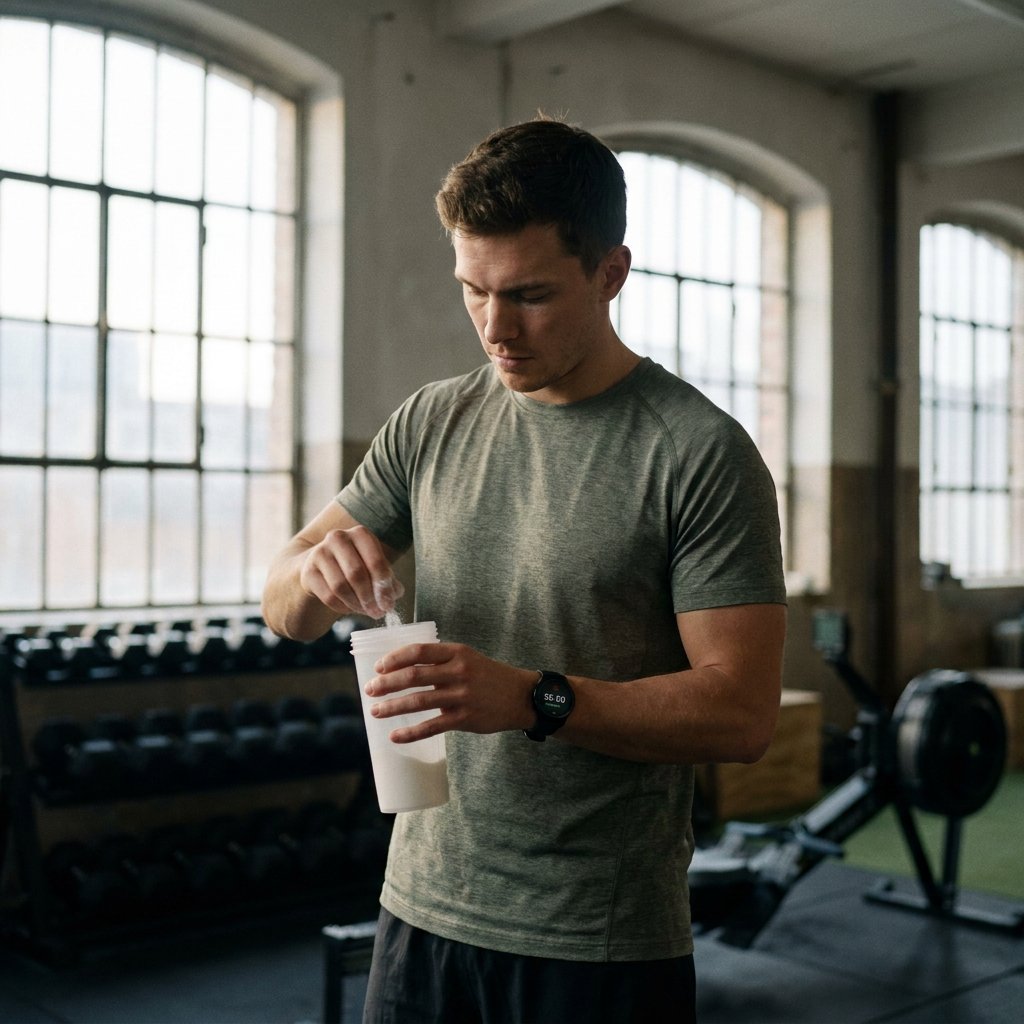
Beta alanine is an ingredient that often appears in sports nutrition and pre-workout formulas, especially among athletes looking into intense effort, acidosis and dosage. If you are searching for information about beta alanine for performance, you usually want to know quickly what it is, how it is used in a sports context, how much beta alanine is commonly taken and which types of training it may be relevant for. On this page, you will therefore find a practical, clear explanation without unnecessary detours. If you want to place the topic in the broader context of sports nutrition, check out proven supplements for sports performance.
BEKIJK SUPPLEMENTEN MET DEZE INGREDIËNTEN
What exactly is beta alanine?
Beta alanine is a non-essential amino acid that naturally occurs in the body and is also obtained in small amounts through food, especially from animal products. In a sports context, it is usually mentioned because of its relationship with carnosine in muscle tissue. That is why you often see this ingredient in articles about intense exercise, repeated sprints, interval training and efforts that roughly last between 30 seconds and 10 minutes.
Beta alanine is not the same as carnosine itself. Rather, it is often discussed as a building block in that process. That is why supplement information usually includes not only the name beta alanine, but also references to muscle buffering, acidosis and loading phases.
The relationship between beta alanine and carnosine
To properly understand beta alanine for performance, the link with carnosine is the most important starting point. Carnosine is a compound found in muscles and is formed from beta alanine and histidine. In many explanations about sports nutrition, beta alanine is seen as the limiting factor in that process, because histidine is generally already present in sufficient amounts through a normal diet.
That is why supplement protocols usually focus on beta alanine rather than direct carnosine intake. In practice, the explanation almost always follows the same line: when athletes increase their intake of beta alanine, this is discussed in relation to carnosine levels in the muscles. That is exactly why beta alanine appears so often in content about intense performance and acidosis.
Why beta alanine is often mentioned for intense exercise
Beta alanine is mainly discussed in training formats where intensity is high and the load rises quickly. Think of intervals, repeated sprints, rowing sets, hard climbing blocks on the bike or heavy sets with limited rest. In that kind of context, acidosis often plays a major role in how an effort feels and how long a high output can be sustained. If you want more background on concepts such as intensity and exertion levels, read what is VO2 max.
That is also why you often see search queries and People Also Ask questions such as "is beta-alanine good for performance?" and "is beta-alanine effective against acidosis?". The interest therefore usually does not come from a general health angle, but from a very specific sports question: how is beta alanine used around efforts with a highly intense character? Many athletes compare beta‑alanine with creatine; for background, see creatine for sport: what does the science say.
BEKIJK SUPPLEMENTEN MET DEZE INGREDIËNTEN
How does beta alanine work in the context of acidosis?
When training intensity rises, the accumulation of hydrogen ions in the muscles also increases. In sports language, this is often summarized as acidosis. In that context, carnosine is described as a buffer in muscle tissue. That makes the combination of beta alanine, carnosine and acidosis a recurring theme in virtually all high-performing content on this topic.
It is important to look at this in a sober way: beta alanine does not work like an acute ingredient that you directly "feel" after a single dose in the form of a performance difference. The best-performing pages instead show that the topic is usually explained from the perspective of building up over time, with a loading phase and daily intake. That is also why terms such as loading phase, distribution and maintenance dosage are so often searched together with beta alanine.
Which sports is beta alanine relevant for?
The SERP analysis clearly shows that beta alanine is mainly linked to sports involving high intensity or repeated peak efforts. The most frequently mentioned examples are:
- cycling, especially for climbing, sprints and intense blocks
- running, particularly middle-distance events and interval training
- rowing and swimming
- team sports such as football and hockey
- HIIT and circuit training
- strength training with heavy sets and short rest
- BMX, mountain biking and other explosive endurance sports
The recurring common denominator is not necessarily the name of the sport, but the effort profile. Beta alanine is mainly discussed for efforts of roughly 30 seconds to 10 minutes, or for longer endurance efforts that regularly include hard peak moments.
Is beta alanine good for cyclists?
This question often comes up in search results, and that makes sense. Cycling combines endurance with recurring intense moments, such as attacks, climbs, final sprints and block training. That makes the sport a good fit for the type of efforts in which beta alanine is often discussed.
For cyclists, what matters most is whether their training and races consist of repeated intense segments. An easy endurance ride has a different profile from a criterium, hill time trial or interval session. So when someone searches for beta alanine for cyclists, they are usually not looking for general information about cycling, but for the match between the effort profile and the use of this ingredient.
How much beta alanine do you need?
One of the most searched questions is how much beta alanine is needed for optimal performance. In the top pages analyzed, the practical advice varies somewhat, but there is still a clear common thread. A lot of content mentions a daily intake between about 3.2 and 6.4 grams, often divided into several smaller servings. Other pages specifically mention 4.8 grams per day during a loading phase.
What stands out most is that the emphasis is rarely on a one-time pre-workout moment. Instead, it is usually explained that athletes use beta alanine over several weeks, often spread throughout the day. The reasoning behind that is practical: smaller dosages are often better tolerated and fit how this ingredient is generally used.
Practical dosages you often see
- 3.2 grams per day as a lower practical starting point
- 4.8 grams per day as a commonly mentioned loading phase intake
- up to around 6.4 grams per day, divided into several portions
- smaller portions of about 0.8 to 1.6 grams at a time
Why spreading intake throughout the day is often recommended
Spreading intake across the day keeps coming back in the analyses for two reasons. First, it is practical when you use multiple grams per day. Second, it is often intended to reduce the well-known tingling sensation after intake. That is why some pages also mention slow-release tablets or taking it with meals.
Loading phase and maintenance phase explained
With beta alanine, you often come across the term loading phase. This means that daily intake is relatively high for a number of weeks. In the analyzed content, this usually refers to a period of about 4 to 8 weeks, with 6 weeks as a frequently mentioned practical example. After that, some pages describe a maintenance phase with a lower daily dosage.
Not every source works this out in exactly the same way, but the main line is consistent: beta alanine is usually discussed as an ingredient you build up over time, not as a single-moment product that is only relevant right before training. That distinction matters for anyone searching terms such as beta alanine dosage or beta alanine usage advice.
Beta alanine in food compared with supplementation
Beta alanine also comes in through food, especially from meat and fish. In the top content, the example is often used that a normal serving of chicken provides a relatively limited amount compared with the quantities mentioned in supplement protocols. This is mainly intended as an illustration of scale: daily sports dosages are generally clearly higher than what you quickly get from normal food portions.
For vegetarians and vegans, this is especially relevant because they use fewer or no animal sources. At the same time, it remains important not to treat food and supplementation as the same thing. The context, quantity and application are different, and that explains why this topic is so often discussed separately.
Beta alanine and the tingling sensation
A well-known point with beta alanine is paresthesia, or a temporary tingling or prickling sensation on, for example, the skin, neck, hands or face. This is explicitly mentioned on several ranking pages because for new users it is often the first noticeable experience.
That feeling is usually linked to larger single doses. That is why usage advice often recommends dividing the total daily amount into smaller portions. Slow-release variants are also regularly mentioned. So people searching for beta alanine for performance are often not only looking for its function or sports application, but also for how to practically deal with this kind of user experience.
When is beta alanine usually taken?
Timing differs by source. Some pages mention taking it before training, while others emphasize daily consistency rather than a specific time. Based on the analyses, the most useful summary is therefore: in a lot of content, timing seems less important than regular intake and sufficient distribution across the day.
In practical terms, beta alanine is often taken:
- spread across the day
- with meals
- as part of a loading phase lasting several weeks
- in tablet, capsule or powder form
For a broader educational context around training and recovery, also read what pro athletes do differently for recovery and performance.
Use beta alanine on its own or in a pre-workout?
Beta alanine is often included in pre-workout products, but it is also available on its own as a powder, capsule or tablet. In informative content, that distinction is useful because the label dosage in a pre-workout does not always match the amounts mentioned in standalone beta alanine protocols.
People who want to look purely at the ingredient itself therefore sometimes deliberately choose a standalone form. Those mainly looking for convenience often end up with a formula in which several ingredients are combined. Whichever form you choose, it does not change the fact that in the SERP beta alanine is mainly explained from the perspective of daily buildup and not just from a short pre-workout effect moment.
Practical overview
| Topic | What you need to know |
|---|---|
| What is it? | A non-essential amino acid that in sports context is mainly discussed because of its relationship with carnosine. |
| Relevant for | Intense efforts, repeated sprints, interval training and sports moments with a lot of peak load. |
| Commonly mentioned duration | Mainly efforts of about 30 seconds to 10 minutes, or endurance sports with intense peaks. |
| Daily intake | Often mentioned: around 3.2 to 6.4 grams per day, divided over several intakes. |
| Loading phase | Often discussed as use over several weeks, usually around 4 to 8 weeks. |
| Known user experience | A temporary tingling sensation, especially with larger single doses. |
Frequently asked questions about beta alanine for performance
Is beta-alanine good for performance?
That question is usually asked in the context of intense training and sports performance. In the best-performing content, beta alanine is mainly discussed for high-intensity efforts, repeated peak moments and sports in which acidosis plays a role. So its relevance strongly depends on the type of effort you are looking at.
Is beta-alanine effective against acidosis?
In informative explanations, beta alanine is almost always linked to carnosine and muscle buffering. That is why it often appears in content about acidosis during intense exercise. Most sources explain this through the role of carnosine in muscle tissue and its application in high-load training.
How much beta-alanine do I need for optimal performance?
Many pages mention a daily dosage between about 3.2 and 6.4 grams, often spread over multiple moments. One specific commonly mentioned protocol is 4.8 grams per day during a loading phase. The exact choice differs by product form, label and usage approach.
Is beta-alanine good for cyclists?
Beta alanine is often discussed in relation to cycling, especially for training or races involving sprints, attacks, climbing and other intense peaks. For easy endurance training, the context is different than for explosive or repeated hard efforts.
Do you need to take beta alanine every day?
In most ranking content, yes. The explanation usually focuses on daily intake over multiple weeks, not only on use right before a workout. That is why you so often see terms such as loading phase, maintenance phase and spreading intake throughout the day.
Why does beta alanine cause tingling?
That tingling sensation, also called paresthesia, is a well-known user experience that is mainly mentioned with higher single dosages. That is why many sources advise smaller portions at a time or a slow-release form.
Can you get beta alanine from food?
Yes, but the amounts in a normal diet are usually lower than the dosages used in supplement schedules. That is why many articles make a separate distinction between daily nutrition and targeted supplementation.
Is there a difference between beta alanine powder, capsules and tablets?
The active substance is the same ingredient, but the practical application can differ. Powder makes flexible dosing easier, while tablets and capsules may be more convenient for fixed portions. Some products also use a slow-release form to spread intake.
Beta alanine in short
People searching for beta alanine for performance are usually looking for three things: what it is, how it relates to acidosis and carnosine, and how much is typically used in practice. The top Google results clearly show that especially athletes involved in intense or repeated peak efforts are interested in this ingredient.
Share:
Lion's Mane and the gut: neutral explanation | VIBEFUEL
Biohacking for beginners: how to start simply and practically