

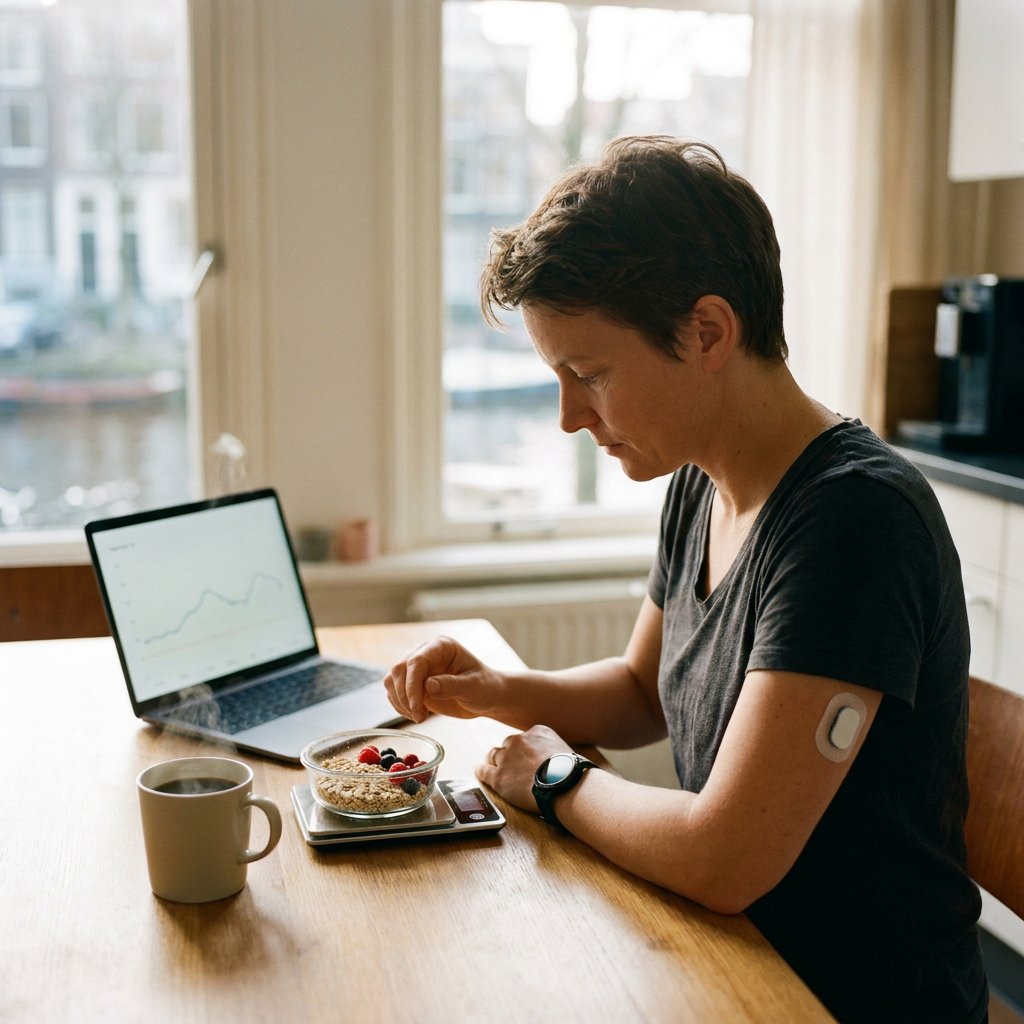
A biohacker diet is usually not a fixed diet with one shopping list or forbidden food groups. Within biohacking, nutrition is mainly about observing, measuring and adjusting step by step. You look not only at what you eat, but also at when you eat, how much you eat and how those choices fit into your daily routine. It is exactly this practical, measurable approach that makes the topic interesting for people who want structure without blindly following a nutrition hype.
Where a classic diet often starts with rules, a biohacker diet usually starts with data and self-observation. Think of a food log, fixed meal times, macro distribution or experiments with meal timing. That connects the topic to the core of biohacking: testing and comparing small changes instead of simply assuming that something works for everyone.
What exactly is a biohacking diet?
The question “what is a biohacking diet?” is often asked as if there is one official method, but in practice it is broader than that. A biohacking diet is a way of eating in which nutrition is approached as a variable you can consciously adjust. So it is not just about healthy eating in a general sense, but about systematically looking at your eating pattern, meal composition and meal timing. Anyone who first wants to better understand what biohacking actually is will also see more quickly why nutrition comes up so often within it.
That is why a biohacker diet often suits people who like experimenting with structure. For example, you can make your breakfast more consistent for a period, stick to a fixed eating window or log your meals to recognize patterns. The label of the diet is not central; the real question is which approach you can actually follow and monitor.
Within this approach, different eating styles appear, such as high-protein breakfast structures, intermittent fasting, a focus on unprocessed foods or a fixed macro split. These are not mandatory elements, but examples of how biohackers organize nutrition in a practical way.
How is a biohacker diet different from a regular diet?
A regular diet is often goal-driven and tightly defined: you follow a plan, cut certain foods or stick to a fixed calorie limit. A biohacker diet is usually less dogmatic. The approach is to change one factor at a time, measure what happens and then decide whether to continue or adjust.
You mainly see that difference in the mindset behind it. With a traditional diet, the question is often: “Which rules should I follow?” With a biohacker diet, the question is more like: “Which nutrition structure can I test and how do I track it objectively?” As a result, measurement plays a much larger role than in many standard diets.
- You work more often with a logbook or app
- You pay attention to meal timing alongside food choice
- You prefer changing one variable at a time
- You look for a structure that is practical to maintain
- You base choices less on hype and more on observation
The main pillars of a biohacker diet
1. Unprocessed and recognizable foods as the foundation
In a lot of biohacking content, unprocessed food forms the foundation. Not because that is an exclusive rule, but because recognizable meals are easier to plan, log and compare. If your nutrition changes too much, it becomes harder to spot patterns in your eating structure.
Think of meals with clear components such as a protein source, carbohydrate source, fat source and fiber-rich ingredients. That gives you more control over composition and timing than when you mainly rely on highly processed or constantly changing choices. For background and structure around nutrition choices that put your gut first, see Improve gut health.
2. Meal timing and fixed eating moments
Within a biohacker diet, not only the content of a meal gets attention, but also the moment when you eat. Some people use an early breakfast, others fixed lunch and dinner times or a limited eating window. The goal of such a structure is not to follow a universally perfect schedule, but to remove noise from your day so you can compare more consistently.
People who eat at different times every day often notice that tracking produces less useful information. With fixed eating moments, you can observe your nutrition routine much more clearly.
3. Macro distribution and meal structure
A biohacker diet often looks at how meals are built. That does not mean everyone has to count macros, but it does mean you can consciously pay attention to the ratio of proteins, carbohydrates and fats. Especially in an experimental phase, that can help make meals more consistent.
A practical approach is to standardize one meal a day first. That makes it easier to see how that meal fits into your week, without having to overhaul your entire eating pattern right away.
4. Measuring and logging
Measuring is one of the clearest characteristics of biohacking. With nutrition, that often means keeping a food diary, noting eating moments, tracking macros or simply writing down everything you eat for a period. That turns a vague feeling into a concrete overview.
You also see this approach in high-performing biohacking content: nutrition is not viewed separately from tracking there. Without a log or fixed measurement method, a biohacker diet often remains little more than a good intention.
If you also want to explore supportive ingredients alongside nutrition, you can do that separately without mixing up food and supplements.
BEKIJK SUPPLEMENTEN MET DEZE INGREDIËNTENWhat do biohackers eat for breakfast?
The question “what do biohackers eat for breakfast?” comes up often because breakfast is the easiest meal for many people to structure. There is no universal biohacker breakfast, but there are patterns that come back often: simple composition, clear portions and relatively little variation if you want to test something.
A breakfast within a biohacker diet is therefore often practical and repeatable. Not necessarily special, but especially suitable for planning consistently. Vibefuel also writes, for example, about the 30-30-30 breakfast rule as a structure model for breakfast within a biohacking context.
Practical breakfast examples within a biohacker diet
- Quark or skyr with nuts, seeds and oats
- Greek yogurt with muesli or granola and fruit
- Whole grain bread with cottage cheese or sliced chicken
- Eggs with wraps, vegetables or beans
- Tofu scramble with whole grain toast
- Oatmeal with milk or a plant-based alternative and an extra protein source
What these breakfast options mainly have in common is structure. They are easy to repeat, reasonably easy to log and simple to adjust if you want to experiment with portions or composition. For your first drink of the day, there are neutral options that fit a measurable routine; see What to drink in the morning for gut health.
Which nutrition strategies do you often see within biohacking?
People searching for a biohacker diet are often not only looking for a definition but also for examples of methods used within biohacking. Those methods differ significantly from one another. The most important thing is therefore not to try everything at once, but to understand which variables you are actually changing.
Intermittent fasting
Intermittent fasting is one of the best-known examples within biohacking. In practice, it usually means working with a fixed eating window, such as a certain number of hours per day in which you plan your meals. Within biohacking, this method is often approached as a structure tool: you test whether a clear eating window is practical and fits your daily schedule.
High-protein breakfast or fixed breakfast structure
Another common strategy is standardizing breakfast. That can be done through a high-protein meal, but also simply by eating the same type of breakfast every workday. For people with a lot of variation in their morning routine, this is often an accessible first step.
Working with macros
Some biohackers choose to track proteins, carbohydrates and fats for a period. Not necessarily as a permanent lifestyle rule, but to better understand what their current eating pattern looks like. This is especially useful if you often eat by feel and do not have a clear picture of your daily structure.
Unprocessed food and simple meals
A focus on less processed food also comes back often. Within biohacking, this approach is mainly practical because simple meals are easier to reproduce. That allows you to compare more clearly what you are actually doing throughout the week.
How do you measure a biohacker diet?
A biohacker diet without a measurement method quickly remains an ordinary nutrition intention. That is why this topic deserves more depth. In SERP analyses, you see that measuring, logging and data are recurring strong elements. For this topic, that makes sense: that is exactly where biohacking distinguishes itself from general diet content.
Measuring does not have to be complicated. For most people, a logbook or app is already a great starting point. The goal is not to track everything forever, but to temporarily get a clear view of your pattern. The more consistently you measure, the more useful your observations become.
Simple ways to log your nutrition
- Use a nutrition app for meals and macros
- Write down eating moments and snack moments in your notes app
- Keep a paper logbook for 7 to 14 days
- Take a photo of each meal to review patterns
- Compare your fixed breakfast, lunch and dinner per day
What can you track in such a logbook?
| Category | What you record | Why it is useful |
|---|---|---|
| Eating moment | Time of breakfast, lunch, dinner and snacks | Gives insight into routine and meal timing |
| Meal composition | Which foods and portions you eat | Makes comparison between days possible |
| Macro distribution | Approximate ratio of proteins, fats and carbohydrates | Helps standardize meals |
| Consistency | How often you deviate from the plan | Shows whether an approach is practical to maintain |
| Eating window | First and last meal of the day | Makes timing experiments measurable |
How to start a biohacker diet without boxing yourself in
The biggest mistake when starting a biohacker diet is trying to change too much at once. Then after a week, you still do not know what you actually tested. A better approach is to start small and first make your current pattern visible.
For beginners, a short observation phase often works better than jumping straight into a strict protocol. For example, log what you normally eat for one to two weeks. Then choose one element you want to structure, such as breakfast, lunch or a fixed eating window. Only after that should you adjust the next variable.
Step-by-step plan for beginners
- Track your normal eating pattern for 7 to 14 days
- Choose one meal you want to structure more easily
- Work with fixed times or one fixed base recipe
- Repeat that approach for at least a week
- Only then compare whether you want to adjust anything
This approach keeps biohacking practical. You do not have to follow every trend right away, but first build a system you can maintain. If you want an even simpler starting point, you can also read Biohacking for beginners: simple practical start.
Common misconceptions about the biohacker diet
The topic of the biohacker diet is often surrounded online by big claims, while the core is usually much more down-to-earth. A few misconceptions keep coming back.
A biohacker diet is not a fixed menu
There is no official biohacker meal plan that applies to everyone. The term refers more to an approach than to one eating list.
More supplements do not automatically make an eating pattern biohacking
Within the context of vibefuel.com, it is important not to mix up nutrition and supplements. A biohacker diet is first and foremost about eating structure, logging and experimenting with food. Supplements are at most a separate topic next to that, not the definition of the diet itself.
Measuring does not have to be high-tech
You do not need an advanced wearable to start with a biohacker diet. A simple logbook, notes app or meal plan can already be enough to make your pattern visible.
Which biohacks really work within nutrition?
The question “which biohacks really work?” is understandable, but difficult if you are looking for one universal answer. Within nutrition, the simplest interventions are often the most practical: planning meals, choosing fixed eating moments, standardizing breakfast and logging your nutrition for a period. Those are not spectacular hacks, but they are concrete ways to create structure.
For most people, a consistent approach produces more useful information than constantly switching between trends. That is why you often see simple routines come back more often than extreme nutrition protocols in biohacking content. The value is not in the dramatic label, but in repeatability and measurability. That also aligns with the five principles of biohacking that are often used as a foundation.
Biohacker diet and supplements: what is the difference?
A biohacker diet is about your eating pattern. Supplements are separate products that stand apart from that. In an informational context, it is important to keep that distinction clear. If you only add supplements without doing anything with meal structure, timing or logging, you are not automatically following a biohacker diet.
If you want to read more about individual ingredients or Vibefuel’s range, keep that separate from your nutrition analysis. Start with your basic pattern first and only then look at which additional information is relevant for you.
Practical summary: how to make your nutrition biohacking-proof
- Choose an eating structure you can repeat
- Log your nutrition temporarily to make patterns visible
- Change one variable at a time
- Work with simple, recognizable meals
- Use meal timing as a measurable factor
- See a biohacker diet as a process, not a hype
Frequently asked questions about the biohacker diet
What does biohacker mean?
A biohacker is someone who consciously experiments with lifestyle variables such as nutrition, sleep, movement or routines. The idea is that you do not just try something, but also observe and compare what exactly you are changing.
What is a biohacking diet?
A biohacking diet is not a fixed type of diet, but an approach in which you organize and measure your nutrition systematically. For example, you look at eating moments, meal structure, macro distribution and how repeatable your routine is.
What do biohackers eat for breakfast?
Many biohackers choose a simple and repeatable breakfast, such as quark with nuts, eggs with wraps, oatmeal or a yogurt base with grains. The emphasis is usually on structure and ease of logging, not on one mandatory standard menu.
Do you need to count calories on a biohacker diet?
No, not necessarily. Some people use calories or macros as a temporary measurement tool, while others mainly work with fixed meals, eating windows or a simple logbook.
Is intermittent fasting the same as a biohacker diet?
No. Intermittent fasting can be part of a biohacker diet, but it is not the same thing. Biohacking around nutrition is broader and can also focus on breakfast structure, meal planning or standardizing your eating pattern.
Do you need wearables to start with biohacking and nutrition?
No. For nutrition, a simple logbook is often already enough. Wearables more often play a role in sleep, movement or general tracking, but they are not a requirement to understand your eating pattern better.
How long should you test a nutrition change?
That depends on what you change, but for practical observation a period of 7 to 14 days is often used. That gives you enough repetition to see whether a structure fits into your daily life.
Is a biohacker diet suitable for beginners?
Yes, especially if you start small. The most accessible start is not an extreme protocol, but a short measurement phase followed by one concrete adjustment, such as a fixed breakfast or a more consistent eating window. If you want to continue with more structure after that, you can also look at the Biohack protocol: practical guide & routine.
Share:
Main Areas of Biohacking Explained | VIBEFUEL
Beste wellness hacks