

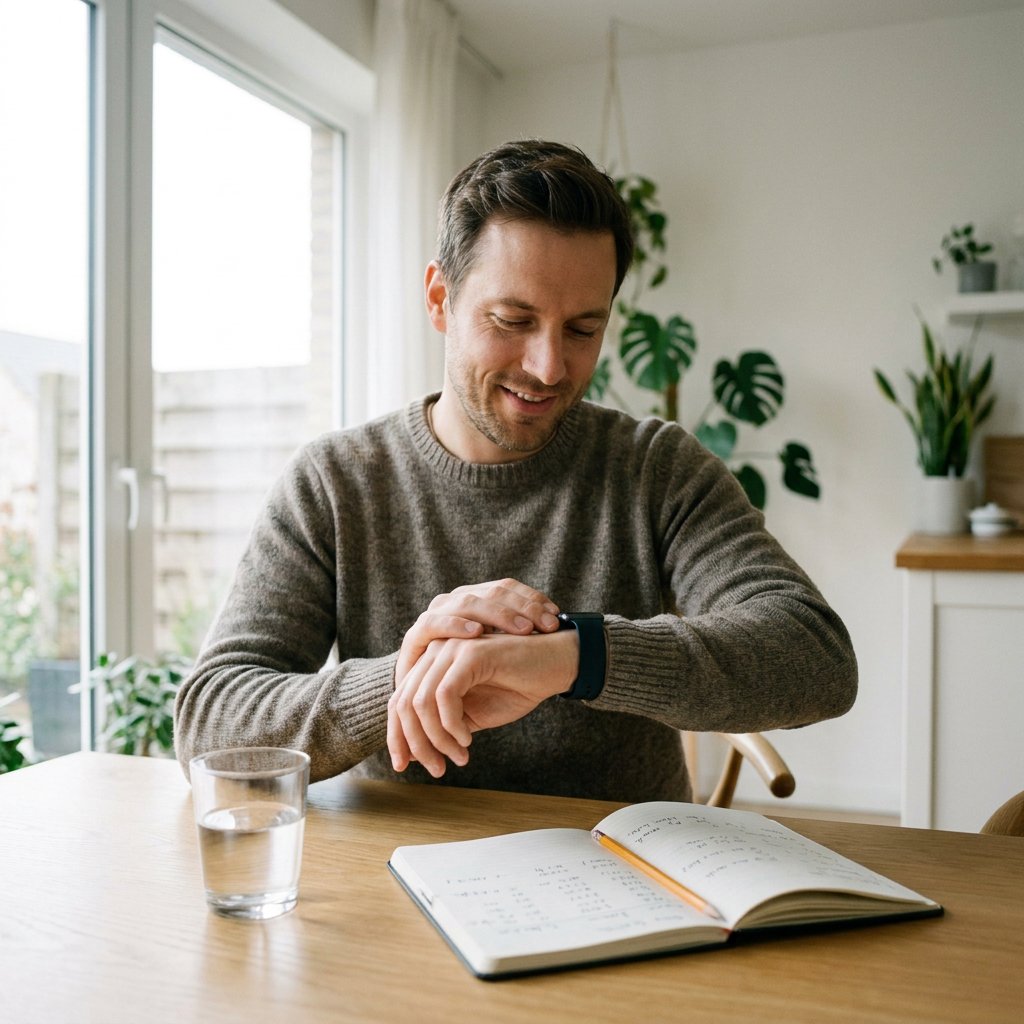
If you have to name one most common biohack, you usually end up with self-tracking using a wearable. A smartwatch, ring or fitness tracker features on almost every biohacking page, because it lets you follow behaviour and patterns without starting complicated protocols straight away.
After that come well-known classics such as sleep optimisation, morning light, intermittent fasting, breathing exercises, cold showers, sauna and supplements. What stands out is that in practice biohacking often isn't about extreme experiments, but about ordinary routines that people want to organise more consciously, measurably or tightly.
What people usually mean by biohacking
The question of what biohacking is comes up often, because it is a broad term. Online it sometimes concerns futuristic topics such as implants or genetic experiments, but in most search results it means something much more practical. It's about consciously tinkering with sleep, nutrition, movement, light, temperature and measurements. A handy framework for organising the concept is the five principles of biohacking.
You can see biohacking as purposeful experimenting with your own lifestyle. The difference from general lifestyle advice lies mainly in the approach. You adjust one variable, keep track of what you do and compare that over time. That is why many articles contain not only explanations, but also concrete examples such as wearables, fasting, daylight or sleep tracking, often divided over the three main areas of biohacking.
Why this approach is so popular
The popularity of biohacking comes mainly from accessibility and measurability. Apps, smartwatches and rings make it easy to track steps, sleep duration, heart rate or other values. As a result, biohacking feels concrete to many people: you do something, you note it down and you see numbers come back.
In addition, routines such as cold showers, fasting and morning light spread quickly via podcasts, social media and news articles. At work, this ties in with simple attention tools, such as reducing distractions at work. The most common biohacks are usually also the least complicated. You often don't need specialist equipment, at most a note-taking app, a timer or a wearable. That explains why these very topics keep coming back on the best-ranking pages.
The single most common biohack: wearables and self-tracking
If you are looking for a single answer, most signals point towards wearables and self-tracking. Think of smartwatches, fitness trackers and rings that register steps, sleep duration, heart rate, temperature or heart rate variability. Some people combine that with a sleep diary, food log or training app.
This form of biohacking is so common because it combines two things: it is easy to use and it provides data straight away. As a result, measuring and tracking often becomes the base layer under other biohacks. Anyone who wants to follow their sleep, sharpen their rhythm or test an eating window often starts with measuring.
It is wise to see such devices as a tool and not as a medical judgement. Data without context says little, and different devices can show different results. That is exactly why biohacking also involves looking soberly at what you measure, how you measure and what you then do with that information.
Other biohacks you often come across
Sleep, daylight and circadian rhythm
Many biohacking routines revolve around sleep and light. That usually means fixed bedtimes, less bright light late in the evening, a dark bedroom and going outside early in the day. In articles about circadian rhythm you also often see attention to screen use, timing and regularity. A well-known rule of thumb is the 10-3-2-1-0 sleep hack.
This type of biohack is popular because it requires little technology and is easy to combine with tracking. People often link such routines to sleep tracking, bedtimes or simple notes about their daily rhythm.
Nutrition, timing and intermittent fasting
Intermittent fasting is almost a standard item on lists of common biohacks. In practice this usually means a fixed eating window, such as 16:8. Food diaries, timing meals and choosing less processed food also regularly fall under biohacking.
The central idea in this area is not just what you eat, but also when and how consistently you do so. That makes fasting fit well into the biohacking logic of testing, recording and comparing over several days or weeks.
Breathing, heat and cold
Breathing exercises, cold showers, ice baths, saunas and infrared cabins are also often mentioned. Some people use short breathing protocols, others make heat and cold a recurring part of their weekly routine. Online these are strikingly visible biohacks, partly because they are easy to share in video and social content.
At the same time, protocols vary greatly here. Temperature, duration and frequency differ per source, so comparing soberly remains important. What often appears in content is not automatically a fixed standard.
Supplements within biohacking
Supplements are also often grouped under biohacking. In such overviews you usually see vitamins, minerals, omega-3, probiotics or mushroom extracts. It is important to look at them factually and without claims: what exactly is on the label, which dosage is mentioned and are there officially authorised claims?
Being popular and being appropriate are not the same. Especially with ingredients without approved health claims, product information should remain restrained and informative. Within biohacking, a supplement is therefore mainly a frequently mentioned part of the conversation, not automatically the starting point.
How to start simply without doing everything at once
Anyone looking for biohacking for beginners usually benefits more from one clear routine than from a list of ten trends. The most practical approach is small, measurable and temporary.
- Choose one biohack for a short test period, for example sleep tracking or a fixed eating window.
- Decide in advance what you will and won't record, so you don't try to measure everything at once.
- Keep track of the context, such as work pressure, travel time, training or caffeine use.
- Only then change a next variable, so you can keep your observations apart better.
That way a biohack protocol: practical guide stays manageable. You also prevent not knowing afterwards which adjustment went with which measurement or note.
What to watch out for with biohacking
The line between an ordinary routine and an ill-advised experiment is sometimes thin. Extreme calorie restriction, prolonged fasting, very cold exposure or a strong dependence on data in particular call for extra caution. What is presented online as a universal hack is often context-dependent in practice.
If you have a medical condition, take medication, are pregnant or want to make drastic changes, professional guidance is the obvious choice. That also applies when a device shows values that worry you. The most common biohacks are usually the simplest: measuring, recording and testing small routines without going to extremes straight away.
Frequently asked questions about biohacking
What are some examples of biohacking?
Frequently mentioned examples are a smartwatch or fitness tracker, sleep tracking, morning light, a fixed eating window, breathing exercises, cold showers, sauna and tracking food or steps. Supplements are sometimes also placed under biohacking.
What does biohacking mean in plain terms?
It usually means consciously experimenting with your own biology or lifestyle. In everyday language, it comes down to testing small adjustments and observing what you do, measure or note.
Who is the best-known biohacker?
Internationally, Dave Asprey is often mentioned as one of the best-known names. More broadly, tech entrepreneurs, podcasters and makers of wearables have also contributed to the popularity of the term biohacking.
Is biohacking suitable for women?
That depends on the chosen routine and personal context. Online advice is often worded generally, while factors such as the menstrual cycle, pregnancy, breastfeeding, training load and medical history can be very relevant.
Is biohacking dangerous?
Not every biohack is risky, but extreme versions can be. Protocols with prolonged fasting, strong temperature stimuli or unclear supplement combinations in particular require more caution than basic routines such as measuring, light and sleep habits.
Which biohack is most common among beginners?
A wearable is often mentioned as the best biohack for beginners, followed by sleep tracking and counting steps. These forms are low-threshold, easy to follow and usually require less adjustment than stricter protocols.
Are supplements necessary for biohacking?
No. In a lot of content, supplements do fall under biohacking, but they are not automatically the starting point. For many people, biohacking actually begins with routines, measurements and timing, while product information should always remain factual and free of claims.
So if you are looking for the most common biohack, chances are you'll end up with self-tracking. You can see the rest as variations on the same pattern: adjusting something small, following it carefully and staying sober about what data and trends do and don't say.
Share:
Best wellness hacks
What is a biohack diet?