

The short, honest answer: we don't know. There is no hard research showing that biohackers as a group demonstrably live longer than people who don't call themselves biohackers. What does often get mixed up in longevity content are three different things: lifespan, healthspan and biological age.
Lifespan is about how many years you live. Healthspan is about how many of those years you function well. Biological age is an estimate based on certain markers or models. If you want to look at this topic soberly, this order helps: first the best-substantiated basics, then the popular biohacks, and finally the question of how to read claims critically. That order ties in with the five principles of biohacking.
Where to look for the real answer: healthspan instead of the biohacker label
There is no solid human research that follows “biohackers” as a group and compares their lifespan with non-biohackers. That would require large, long-running studies with clear definitions, and they don't exist. What does exist are studies on individual habits, measurements and routines.
That is why it makes more sense to look at healthspan than at the biohacker label. Lifespan is total length of life, healthspan is about the years in which you keep functioning well, and biological age is an indirect estimate. In practice, much of biohacking turns out to be a combination of well-known lifestyle choices, measuring and personalising. Interesting anecdotes, podcasts and individual routines are not yet evidence of extra years of life.
Which habits you keep seeing in substantiated routines around healthy ageing
| Domain | What you often see | Type of research | Why this weighs more heavily than a single hack |
|---|---|---|---|
| Strength training | Training regularly with progression, adapted to level and recovery. | Guidelines, intervention studies and a lot of research on function, muscle mass and load capacity. | This is a recurring foundation in serious longevity routines, not something exotic or one-off. |
| Fitness and daily movement | A combination of training and lots of ordinary movement throughout the day. | Lots of population research, supplemented with intervention studies on fitness and exercise response. | It is precisely the combination of structural movement and conditioning work that you see again and again, more often than spectacular protocols. |
| Nutrition and rhythm | Dietary pattern, regularity, energy intake and practical eating structure. | Lots of population research on patterns, plus shorter interventions; for timing, often less hard evidence on lifespan. | Online, patterns, individual ingredients and supplements are often mixed, while these are different levels of evidence. |
| Sleep and recovery | Fixed bedtimes, enough sleep and room between load and recovery. | Cohort research, guidelines and studies with indirect markers such as alertness, recovery and load response. | Here too it's usually about consistent behaviour, not one clever trick. |
What stands out is that precisely this foundation comes back much more consistently than cold baths, stacks or complicated schedules. Personalisation usually only has real value once sleep, exercise, nutrition and recovery are already reasonably stable. Your environment counts too; see biohacking your home: smart adjustments for practical options.
Fasting, cold and other stressors: much discussed, but not the same as lifespan evidence
Fasting, cold exposure and intensive training blocks are often presented as hormetic stimuli: a temporary load to which the body responds. That doesn't make them evidence of a longer lifespan. Many claims rely on mechanisms, animal research or short-term measurements. Whether this practical guide to a biohack routine is worth testing depends heavily on context: your foundation, your total load and your recovery.
Antioxidants, polyphenols and supplements: a mechanism is not yet an outcome
Terms such as oxidative stress, polyphenols and cellular pathways often pop up in longevity content. That sounds precise, but a mechanism is not yet an outcome. The fact that something theoretically influences a certain process doesn't automatically mean that people demonstrably live longer because of it.
Three things are often lumped together here: a dietary pattern (see what is a biohack diet), an individual ingredient in food and a supplement. These are not equal categories. Supplements and nootropics are popular within biohacking, and those topics also come up in the VIBEFUEL knowledge base, but they are not a proven answer to the question of whether biohackers live longer. Discussions often revolve around source, dosage, timing and bioavailability, while the outcome measure is usually not actual lifespan.
Gut microbiome and biological age: interesting data, not a final answer
The gut microbiome, inflammatory pathways and mitochondria often come up in longevity stories because they offer a language to describe ageing. They make complex processes visible in graphs, scores and explanations. That makes them feel concrete and personal: you get the idea that you are mapping a hidden layer of your body.
That doesn't make the data the same as lifespan. A gut test usually shows a profile, ratio or diversity score. A biological age score is often calculated from biomarkers or other model data. Such results can be useful as a snapshot or as a starting point for interpretation, but they remain proxies. They don't directly measure how many years someone gains or loses. More context can be found in our explainer article on biohacking your biological age.
It is precisely at this point that education online quickly shifts towards commerce. The explanation about the microbiome, inflammation or biological age is often linked directly to recommendations, protocols or stacks. As a result, a mechanistic explanation can seem weightier than the evidence actually allows. Content about gut health or biological age can be interesting for better understanding what someone is looking at, but it is not a final answer to the question of whether biohackers live longer.
Why measuring is not the same as living longer
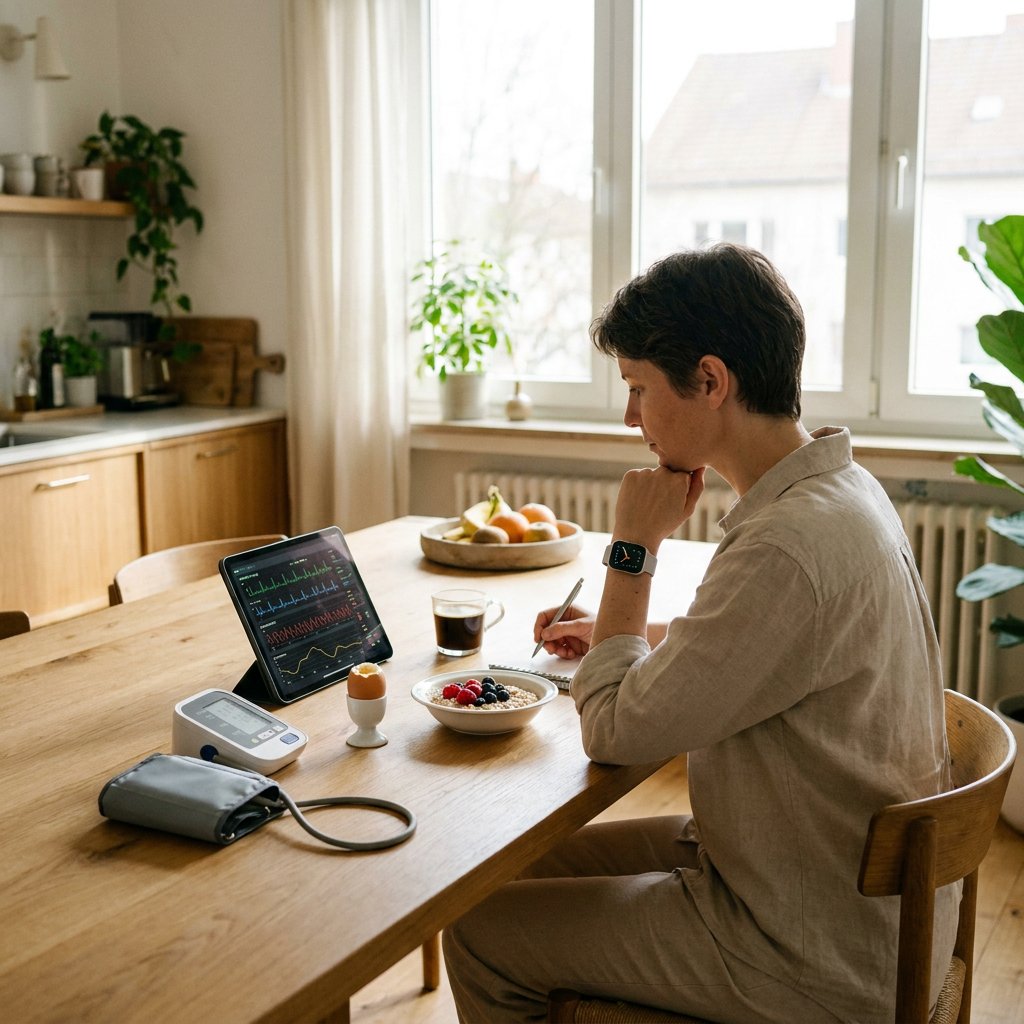
Biohacking is often data-driven. What you can measure, you can track, compare and adjust. But measuring on its own proves nothing about living longer. Most biomarkers mainly provide process information: how you slept, how you responded to training, how stable your rhythm was or how a meal worked out in the short term. That is something other than a direct measure of lifespan.
That is why a trend is often more valuable than a single result. A few late nights can distort sleep data. A heavy training week can temporarily lower recovery metrics. And two devices can score the same night differently. So first compare numbers with your own baseline and look at patterns over a longer period.
Which signals biohackers often track
- Sleep duration and regularity: measures how much you sleep and how consistent your rhythm is; it remains indirect because sleep quality and measurement method can differ.
- Resting heart rate and HRV: give signals about load and recovery; they are sensitive to stress, training, alcohol, illness and the timing of the measurement.
- Training load and recovery: shows how much stimulus you are stacking; it says nothing directly about lifespan.
- Glucose after meals: shows a short-term response to food; context, composition and timing play a big role.
- Subjective energy or mood: self-reporting of how your day feels; useful for patterns, but dependent on how you feel that day and context.
- Individual outliers: one bad night or one low score says little without a pattern over weeks or months.
When tracking turns into false certainty
Tracking can turn into false certainty as soon as every number feels like a judgement. Then you quickly start living for your dashboard instead of using your dashboard as a tool. More data is also not automatically better insight, especially not when metrics contradict each other or you keep adding new devices and scores.
That is why daily functioning, a sense of recovery and consistency remain important alongside the numbers. Data can help you see patterns, but not take away all uncertainty.
How to assess longevity claims soberly
When you read content about living longer, a simple checklist helps. It prevents technical language from sounding more convincing than the evidence itself.
- First look at the type of evidence: does it come from human research, or mainly from cells, animals or theory?
- Then ask what exactly was measured: actual lifespan, healthspan, or only biomarkers and short-term responses.
- Pay attention to the size of the effect. A small change in a marker is not the same as a meaningful difference in lifespan.
- Be careful with terms such as mTOR, AMPK, autophagy, oxidative stress or microbiome diversity. They can be relevant in an explanation, but they are not automatically evidence of living longer.
- Watch for the transition from explanation to offer. If a story quickly ends with a supplement, test kit, dashboard or exclusive protocol, extra critical distance is wise.
- Finally, remember that the least spectacular advice often comes back most often in well-researched longevity content: the three main areas of biohacking first, details later.
Share:
What is a biohack diet?