

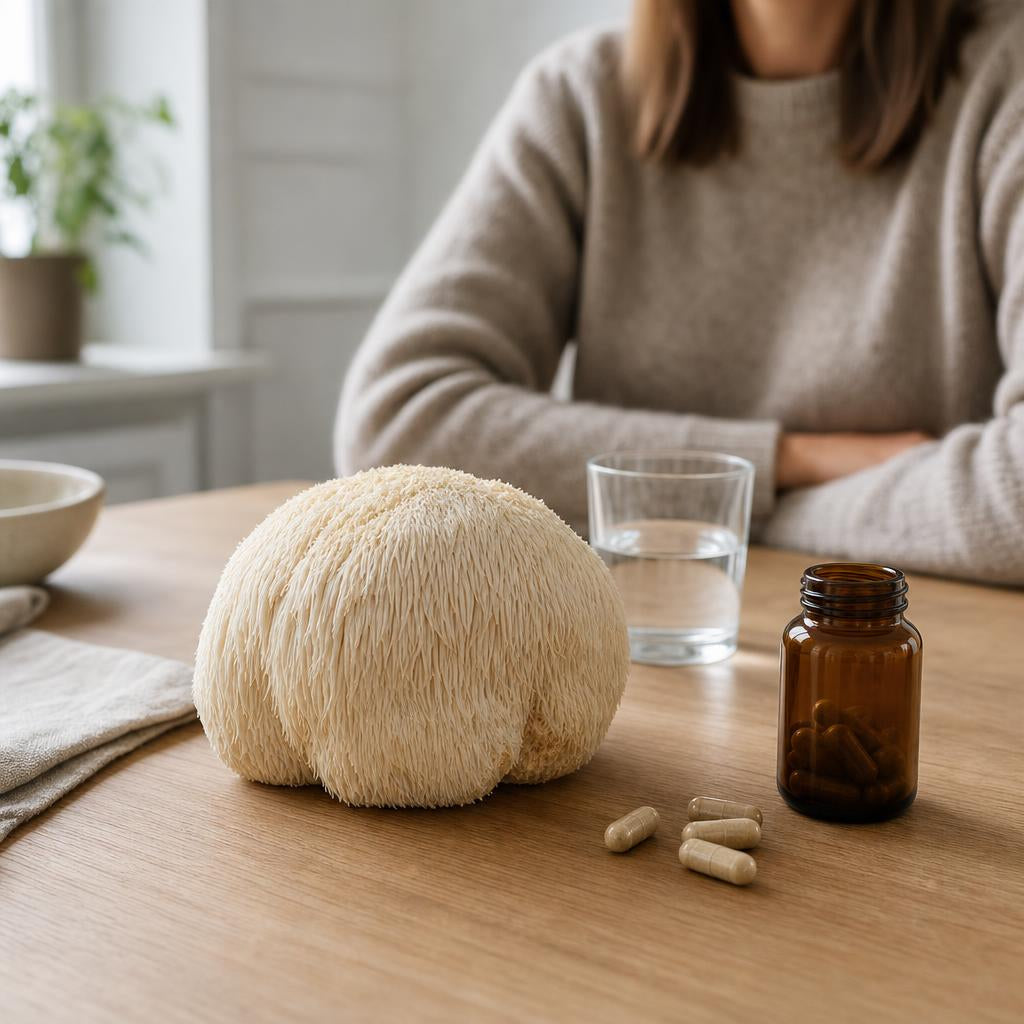
The search query “lions mane anxiety” shows that many people want to know whether Lion’s Mane has anything to do with feelings of restlessness, tension, or anxiety. Online, you come across many claims about this, but with this ingredient in particular it is important to keep facts and interpretation clearly separated. Lion’s Mane is the English name for the mushroom Hericium erinaceus, also known in Dutch as pruikzwam.
In this article, you will therefore find a neutral, informative explanation. You will discover what Lion’s Mane actually is, why it is often mentioned in the same breath as anxiety, what has been examined in research, and which safety questions often come up. We also discuss topics such as side effects of Lion’s Mane, use alongside antidepressants, and the question of whether Lion’s Mane is addictive. This gives you a complete picture without exaggerated promises or unclear health claims.
What exactly is Lion’s Mane?
Lion’s Mane is an edible mushroom with a striking appearance: white, thread-like spines that resemble a lion’s mane, which is where the English name comes from. Its scientific name is Hericium erinaceus. In the Netherlands, the name pruikzwam is also used. The mushroom naturally grows on wood and is found in different parts of the world.
In addition to culinary use, there is considerable interest in Lion’s Mane as an ingredient in supplements. You can find it as powder, extract, capsule, or in blended formulas. In informative articles and product texts, reference is often made to compounds such as polysaccharides, hericenones, and erinacines. These are terms that mainly appear in scientific and semi-scientific contexts.
People searching for Lion’s Mane and anxiety are usually not looking for the mushroom itself, but for information about the relationship between this ingredient and mental complaints. It is therefore important to first understand that Lion’s Mane is fundamentally just a mushroom, and that many online statements revolve around interpretations of studies, tradition, or user experiences.
Why do people search for “lions mane anxiety”?
This search term usually comes from three types of questions. The first is practical: people see Lion’s Mane in a supplement and want to know whether it fits their situation. The second is informational: they have read online that Lion’s Mane is discussed in relation to mood, stress, or sleep and want to know what that actually means. The third is safety-related: they wonder whether Lion’s Mane is safe if you have anxiety symptoms, sensitivity to stimuli, or if you use medication such as antidepressants.
As a result, the search results often show a mix of pages about mechanisms of action, blog articles about the brain, and pages that also mention anxiety, depression, mood, or sleep. Competitive analysis shows that the best-performing pages especially give extensive attention to the combination of Lion’s Mane with anxiety, stress, mood, and sleep, often supplemented with safety information and interactions.
That is exactly why nuance is needed. The fact that an ingredient is often searched together with a complaint does not automatically mean firm conclusions can be drawn. For informative content, it is more useful to look at what exactly has been studied, in which context, in which groups, and with which limitations.
What does research say about Lion’s Mane and anxiety?
If you look at content that ranks highly in Google, it stands out that research on Lion’s Mane and anxiety is usually discussed together with broader themes such as mood, stress, sleep, and mental strain. This often involves small studies with limited groups of participants, different product forms, and varying dosages. That makes it difficult to compare results one-to-one.
Some of the online information refers to studies in healthy adults or specific subgroups, for example middle-aged women, students, or participants with sleep complaints. In addition, the forms of Lion’s Mane used vary widely: dried fruiting body, polysaccharides, or standardized extracts. Study duration also differs considerably, from short interventions to trajectories of several weeks.
Importantly, such studies mainly say something about the specific setup that was examined, not automatically about every Lion’s Mane supplement on the market. Moreover, small studies are more vulnerable to bias and do not provide a definitive answer. People searching “what does Lion’s Mane do to your body?” or “does Lion’s Mane help with anxiety?” often encounter strong statements online, but scientific literature usually calls for caution and further research.
Which types of studies are usually cited?
- Small placebo-controlled studies in healthy adults
- Research in which anxiety is examined together with stress, mood, or sleep
- Studies using different forms of Lion’s Mane, such as powder or extract
- Preclinical research, for example in cells or animal models
- Literature reviews summarizing multiple small studies
Why are the results difficult to compare?
- Not every study uses the same part of the mushroom
- Dosages vary widely
- The studied groups differ greatly from one another
- Outcome measures for anxiety or mood are not always the same
- Small groups make broad conclusions uncertain
Why is Lion’s Mane also mentioned online with mood, stress, and sleep?
In the SERP and in competing content, Lion’s Mane rarely appears only in combination with anxiety. Many pages group the topic with depression, mood, stress, and sleep. This mainly happens because studies and blogs often treat mental themes together rather than strictly separating them. For the reader, that is relevant, because someone searching for anxiety often also has questions about restlessness, sleep, or sensitivity to stress.
At the same time, you should be careful not to translate such broad themes too quickly into personal expectations. For example, an article may mention research in which multiple questionnaires were used at the same time, but that does not mean an equally strong conclusion can be drawn for every individual point. You also often see online that mechanistic theories are directly translated into concrete outcomes for people. In a scientific context, that step is far from self-evident.
If you want to compare sources neutrally, it is wise to pay attention to the studied target group, the form of the ingredient, the duration of use, and the way outcomes were measured. That is more informative than a loose claim such as “good for anxiety” or “works calmingly.”
What does Lion’s Mane do to your body according to general information?
The question “what does Lion’s Mane do to your body?” comes up frequently in Google. Informative pages usually first describe the composition and the compounds present in the mushroom. These include polysaccharides, hericenones, and erinacines. Broader articles also mention terms such as antioxidative processes, inflammatory pathways, and neurotrophic factors.
This kind of explanation is mainly descriptive in nature: it concerns how researchers view an ingredient in laboratory or theoretical contexts. Such information is not the same as an approved health claim. With Lion’s Mane, that distinction is especially important. A mechanism or hypothesis from research does not automatically say what you will notice in practice, or whether a specific supplement will produce the same outcome as in a study.
For those orienting themselves, it is therefore more useful to see general information as background knowledge. It helps you understand why Lion’s Mane is a topic of research, but not to form expectations about personal effects without reservation.
Is Lion’s Mane safe to use if I take antidepressants?
This is one of the most important questions within the topic of lions mane anxiety. The honest answer is that you should handle this carefully. Possible interactions are discussed online, but the available information is limited and often based on theoretical mechanisms, isolated reports, or indirect inferences from research. That is not the same as strong clinical certainty.
With supplements in general, combining them with antidepressants, sleep medication, calming agents, or other psychotropic medication is never something to do based on feeling alone. Especially not if you are already being treated for anxiety complaints, panic, depression, or mood problems. Even if Lion’s Mane itself is seen by some as “natural,” that does not mean combining it is automatically risk-free.
Do you take antidepressants or other medication? Then always discuss supplement use in advance with your doctor or pharmacist. This is especially important if you use multiple products, are sensitive to side effects, have a medical condition, or have reacted strongly to supplements before. Experimenting on your own while looking for relief from anxiety complaints is not a wise route.
When should you be extra cautious?
- When using antidepressants or other medication for mood or anxiety
- When you have a history of panic complaints or strong sensitivity to supplements
- During pregnancy or breastfeeding
- In case of a known mushroom allergy
- In complex medical situations or when combining multiple supplements
What are the negative effects of Lion’s Mane?
People searching for negative effects of Lion’s Mane usually want to know whether there are side effects, whether it can worsen complaints, and whether there are risks with long-term use. Online sources mainly mention mild, general side effects. Think of gastrointestinal complaints, nausea, or skin reactions. In addition, people with a mushroom allergy are regularly warned.
The difficulty is that reports about side effects do not always clearly show which exact product was used, at what dosage, and in combination with which other substances. This especially matters with blended supplements, where Lion’s Mane is not the only ingredient. If someone experiences a reaction, it is therefore not always clear which substance caused it.
For a neutral overview of possible reactions, read: Side effects of Lion’s Mane.
Possible points of attention often mentioned
- Stomach or intestinal complaints
- Nausea
- Skin rash or other allergic reaction
- Uncertainty when combined with medication
- Differences in response by product, dosage, and person
Is Lion’s Mane addictive?
The question of whether Lion’s Mane is addictive comes up surprisingly often. There is a practical reason for that: people who are already sensitive to restlessness or anxiety prefer not to use a product that could trigger cravings, dependence, or an agitated feeling. In general information about Lion’s Mane, it is usually not presented as an addictive substance in the classical meaning of the word.
That said, “not addictive” does not automatically mean it comes without points of attention for everyone. Some people are not mainly afraid of dependence, but of how they subjectively feel after using a supplement. Think of nervousness, an unusual bodily sensation, or uncertainty about combining it with other ingredients. Those are different questions than addiction, but still relevant ones.
If you are sensitive to mental or physical reactions, do not only look at the label “not addictive,” but at the full context: which ingredients does it contain, do you also use medication, and why do you actually want to take it? Especially with the search intent behind lions mane anxiety, that distinction matters.
What should you look for in a supplement with Lion’s Mane?
Not every product with Lion’s Mane is the same. Analyses of well-performing pages clearly show that the difference between fruiting body, mycelium, powder, and extract is regularly mentioned. Standardization, origin, and processing can also differ per product. For a reader who is orienting themselves, that is more relevant than general marketing language.
Therefore, always check the label and product specifications. Pay attention to how many milligrams of Lion’s Mane it contains, which form is used, and whether it is a single ingredient or part of a blend with multiple substances. The latter is especially important when you search for lions mane anxiety, because blended products sometimes also contain other ingredients that may be more relevant to your situation than Lion’s Mane itself.
Also check whether a provider is clear about usage advice, the ingredient list, and warnings. Clear product information helps you compare better and prevents you from basing expectations on general blogs that do not match the composition of the product you are looking at.
You can find practical points of attention about combinations and situations in What to avoid when using Lion’s Mane.
Practical checklist when comparing
- Which form of Lion’s Mane is used?
- How much does a daily serving contain?
- Is it a standalone ingredient or part of a formula?
- Are warnings and usage information clearly stated?
- Do you also use medication or other supplements?
Neutral background on intake and frequency: Lion’s Mane dosage: how much and how often.
Want to review the basics first? Then read What to know before you use Lion’s Mane.
Frequently asked questions about Lion’s Mane and anxiety
Can Lion’s Mane cause anxiety?
There is no simple universal answer to that. Experiences online vary and studies do not provide a basis for a hard, general statement for everyone. If you are sensitive to supplements or already use medication, consult a doctor or pharmacist first.
Is Lion’s Mane the same as an anti-anxiety medication?
No. Lion’s Mane is a mushroom used as an ingredient in supplements. It is not a replacement for medical care, diagnosis, or treatment of anxiety complaints.
How quickly does Lion’s Mane work?
Many isolated claims circulate about this, but they are not one-to-one applicable to every person or every product. The research context, the product form, and your personal situation all play a role.
Can I combine Lion’s Mane with other supplements?
That depends on the composition and on your personal situation. Especially when used alongside medication or other products that may affect mood, sleep, or sensitivity to stimuli, consultation is wise.
What if I am mainly looking for rest or calm?
Then look extra critically at what exactly you are seeking: general ingredient information, product comparison, or medical advice. With persistent anxiety complaints or panic, professional guidance is more important than drawing your own conclusions from blogs or social media.
Is it wise to try Lion’s Mane for anxiety complaints?
With serious or recurring anxiety complaints, it is wise to first talk to a healthcare professional. Especially if you are already being treated or use medication, experimenting with supplements on your own is not a good starting point. You may also read Is Lion’s Mane bad for the liver? if you want to orient yourself more broadly on safety questions.
Read more neutrally about ingredients
Would you like to learn more about ingredients and supplement information? Then view the VIBEFUEL range or read more about ingredients in the knowledge base.
Share:
Coffee and brain fog: effects, causes and practical tips
L-Tyrosine for focus: explanation, research and use