


Adaptogens are a widely discussed topic within nutrition and herbal studies. The term appears in relation to adaptogenic herbs, adaptogenic plants, and adaptogen supplements, but what does it actually mean? In this article, you will get a sober, educational overview of the definition, historical origins, common examples, and how scientists study so-called adaptogenic activity.
From term to criteria: what counts as an adaptogen?
The term adaptogen is used for natural substances and plant extracts that are discussed in the literature in relation to the body’s adaptation processes. In the classical definition (including Soviet-era literature), three criteria are often mentioned: the substance should be non-specific in application, should not disturb normal physiological balance, and should have a broad safety profile in use situations. These criteria describe a conceptual framework and are not a health claim.
Because “adaptogen” is not a protected medical term in the EU, its interpretation can differ by publication or producer. That is why contemporary texts contain varying descriptions of so-called adaptogenic activity. You will also regularly encounter related umbrella terms, such as nootropics and, in a broader context, biohacking. For readers, it is useful to pay attention to source references, context (traditional use, pharmacognosy, or clinical research), and whether a clear distinction is made between historical definitions and current regulatory frameworks.
History: from Soviet research to modern terminology
The adaptogen concept took shape in the 20th century. In the 1940s and 1950s, researchers influenced by Hans Selye’s stress model laid the groundwork for a pharmacological concept intended to classify plants and substances that they believed contributed to general adaptation processes. Within the Soviet and Eastern European scientific context, many publications followed in the decades after, attempting to formulate criteria, testing methods, and quality standards for adaptogenic plants.
This research developed alongside long-standing traditions within Eastern systems, such as Ayurveda and traditional Chinese medicine, where certain herbs and mushrooms had already been classified for centuries as tonics or rasayana. In modern encyclopedias and reference works, you therefore see an interplay of historical, traditional, and scientific perspectives. One mushroom that is often discussed separately in contemporary knowledge articles is Lion’s Mane (pruikzwam).
From the 1990s onward, the discussion in the West shifted more toward regulation and terminology. In the EU, health claims fall under strict regulation. The word “adaptogen” itself is not an EFSA-approved claim, and for many individual plants no approved health claims are available. As a result, the term is used mainly descriptively in the European context: as an indication of a tradition or research direction, not as a guarantee of an established effect. This distinction between cultural history, research developments, and current regulation is important when reading information about adaptogens.
How is adaptogenic activity studied?
When scientists write about adaptogenic activity, they generally refer to hypotheses and models that attempt to explain how certain plant extracts behave in biological systems. Review articles, for example, mention the HPA axis, cellular stress pathways, and molecular chaperone proteins as lines of investigation. Signaling pathways via receptors and transcriptional factors are also discussed in fundamental research. These topics are technical in nature and describe possible interactions without automatically leading to practical conclusions.
It is important to note that many studies differ in design, quality, and outcome measures. As a result, the terminology surrounding adaptogenic plants is not uniform. In European consumer communication, only officially approved claims may be communicated. Anyone reading publications about, for example, Eleutherococcus senticosus effects or terms such as rhodiola complex effects will notice that authors often speak in hypotheses, model descriptions, or laboratory findings. That is fundamentally different from a broadly accepted, regulated health claim for everyday use.
Examples of adaptogenic plants and mushrooms
Books, traditional systems, and scientific overviews often mention the following examples when discussing adaptogenic herbs and adaptogenic plants. This is a non-exhaustive, informative list without health claims:
- Ashwagandha (Withania somnifera) - frequently mentioned in Ayurveda.
- Rhodiola rosea - often described in Eurasian herbal traditions.
- Panax ginseng - a classic ingredient in East Asian herbalism.
- Eleutherococcus senticosus - known from Russian and Chinese literature.
- Schisandra chinensis - traditionally mentioned in TCM sources.
- Astragalus membranaceus - widely used in Eastern herbal systems.
- Reishi and Cordyceps - mushrooms mentioned in traditional contexts.
- Maca (Lepidium meyenii) - an Andean crop with cultural documentation.
- Bacopa monnieri and Tulsi (Ocimum sanctum) - often mentioned in Ayurvedic texts.
- Chaga - a mushroom found in various northern traditions.
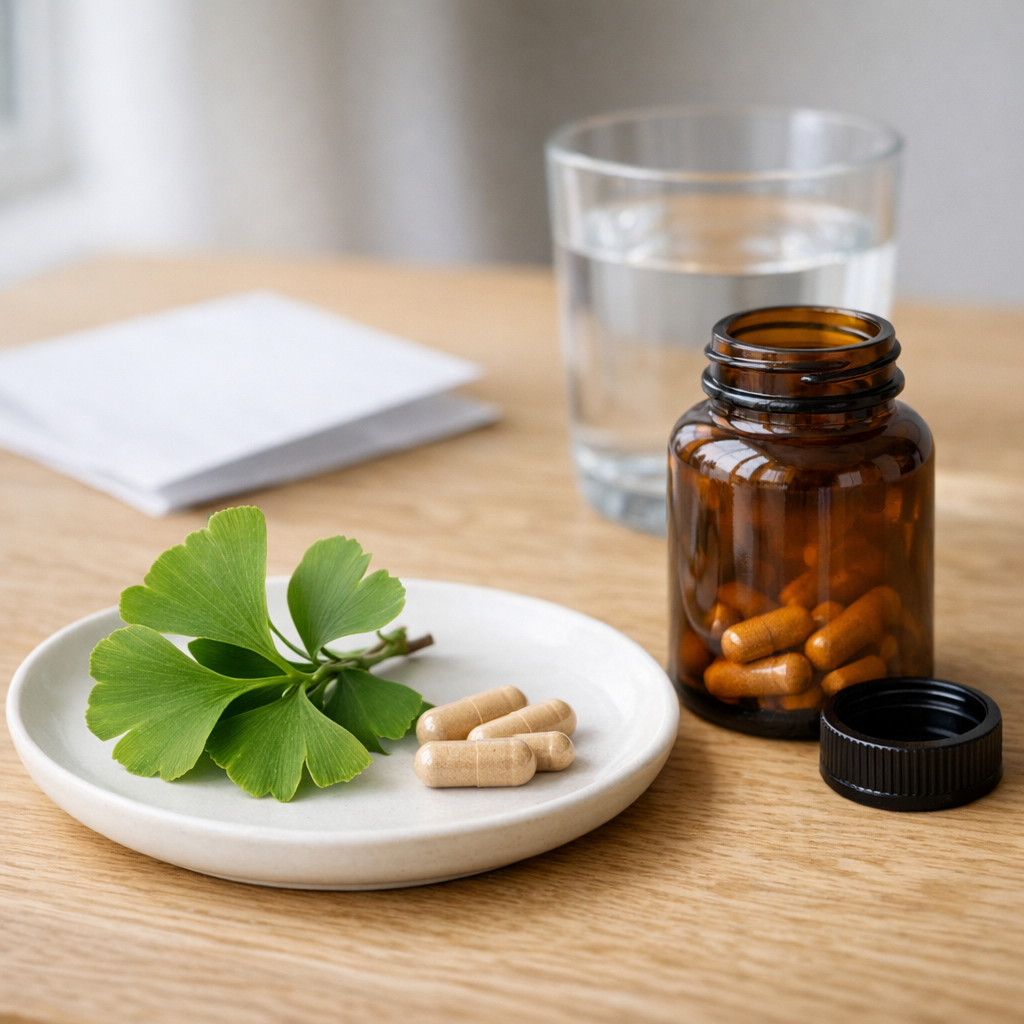
The presence of an ingredient on this list says nothing about permitted claims in the EU. For consumers, it is advisable to consult labels, origin, and standardization information when comparing adaptogen supplements or herbal preparations. Aside from adaptogens, Ginkgo biloba is also regularly covered as a background topic in knowledge articles.
Frequently asked questions about adaptogens
What are adaptogens in short?
Adaptogens are a concept from pharmacognosy and herbal studies used to classify certain plants and natural substances within the theme of adaptation. It is a historical and scientific term, not a specific EU health claim. Meaning and interpretation differ by source.
What do adaptogens do according to research?
Publications describe various models and hypotheses, for example around cellular stress pathways and regulatory networks. However, there is no uniform, EFSA-approved claim for adaptogenic herbs as a whole. Interpreting studies therefore requires context and source criticism.
Want to read more about the ingredients Vibefuel uses? View our overview of nutrients and ingredients.
Want a broader orientation on the topic? Visit the nootropics information page.

To share:
Antioxidants: what are they and what foods contain them?
Improve lung function